Tronc Dance-Fee and Tip Ledger
For clubs that classify their dancers as employees

A “VIP gratuity” the club sets is not a tip.

Tronc keeps every shift’s two kinds of money apart: the dance fees and room charges the club sets, whose dancer share is wages, and the tips customers choose to give. Each week it works out the tip credit actually allowed, the make-up to the minimum wage, the regular rate with the dance share in it, and the overtime premium — with the five records the Labor Department names.

Opens in this browser with an invented club already in it. No account, no email address, nothing installed.
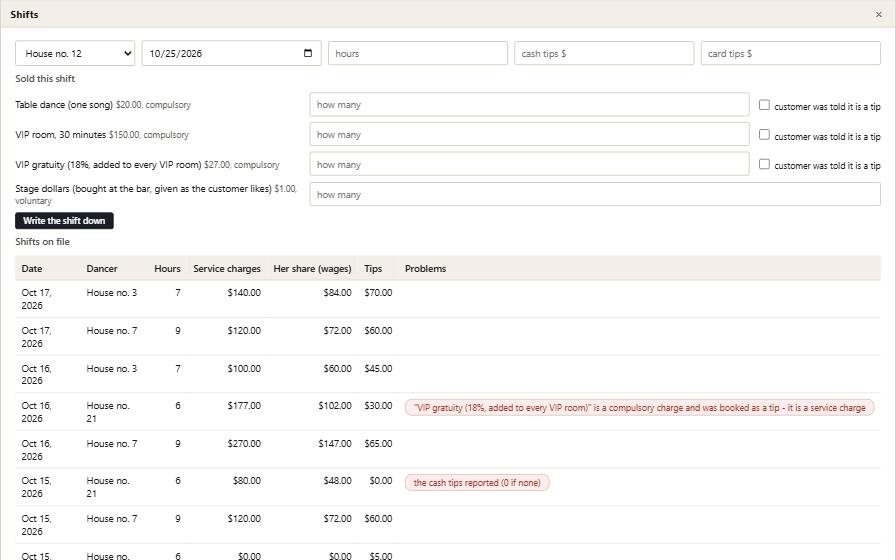
Tronc with its example records in itOpen the free demo →

The problem

Mixing a compulsory fee into “tips” owes every dancer at once.

Under the Fair Labor Standards Act as the Labor Department’s Fact Sheet 15 sets it out, a compulsory charge the club sets is a service charge, not a tip, whatever the menu calls it. What the dancer is paid from it is wages and goes into the regular rate for overtime. A club taking a tip credit pays at least $2.13 an hour cash and makes up any shortfall every week.

Not a tip

a compulsory service charge, whatever it is called on the menu.

DOL Fact Sheet 15 →
$2.13

an hour in cash, at least, for an employer taking a tip credit — with $5.12 the most credit taken.

Records

of the tips employees report, kept by every tip-credit employer.

DOL Fact Sheet 15 →

Will not close a week that owes a dancer money.

A compulsory item booked as a tip is refused, and so is a shift with tips left blank — zero is an answer, blank is not. The week cannot be closed while a shift is incomplete or mis-booked, a cash rate breaks the rules, or a make-up or overtime premium is owed and not yet on the payroll. There is no override.

How it works

Menu, shifts, the week

Set the house menu

Every price the club sets: compulsory or voluntary, and the dancer’s share of each compulsory item.

Write each shift

Hours, every dance and room sold, cash and card tips.

Close the week

Per dancer: cash wage, dance share, tips, tip credit allowed, make-up, regular rate, overtime and gross wages.

What it will never do

It works out what is owed. It does not run payroll.

Tronc holds no bank account and no card. Your payroll pays what it works out.

No payroll run.Tronc shows the figures; payroll pays them.
No daily overtime.California’s daily overtime is not worked out.
It is not a lawyer.Not legal or tax advice.
It never touches a payment.The subscription is for software.

Pricing

Priced per venue

Less than one dancer’s week of make-up.

Most clubs

One venue

$39/month

One club with employee dancers.

  • Dance fees kept apart from tips
  • Weekly make-up and overtime
  • The five records

One venue, yearly

$390/year

The same, two months free.

  • Everything in One venue
  • State wage rules
  • Export for your payroll

Subscription. Your bank statement says Tronc Software. First payment refunded in full on request within 14 days. Your licence key is emailed to you within two working days of payment.

Checkout is our own bitcoin server, not a card processor — nobody we had to apply to and nobody who can close the account. The button takes you straight to it. Give your email address there — that is where your key is sent.

Questions

The ones we actually get asked

Is a table dance a tip?

Not when the club sets the price and the customer must pay it. That is a service charge, and the dancer’s share is wages.

Does the dance share count for overtime?

Yes. It goes into the regular rate, and Tronc works the overtime premium from it.

Our state has no tip credit.

Set the state’s minimum wage and switch the tip credit off. California, Oregon, Washington, Nevada, Minnesota, Montana and Alaska allow none.

Is this legal advice?

No. It is the ledger you wish you had kept.

What do I actually get when I pay?

The demo on this page is the whole program, running on invented records. Paying gets you a licence key — one line of text, emailed to the address you give at checkout within two working days. Paste it into the program and from then on it keeps your own records. Until then, nothing you type into it is kept.

The key is checked inside the page, on your own machine. It never calls us, so there is still no account and nothing about your business goes anywhere. If you ever stop paying, your records stay exactly where they are, read-only, and Export still hands you every one of them.

Open the demo before payroll closes

One invented dancer is short of the minimum wage on a slow week, another is owed overtime on a regular rate that includes her dance share, a compulsory “VIP gratuity” was booked as a tip, a shift has no tips written, and one dancer never got the tip-credit notice.