Represent puts every dispute against the earliest deadline that binds it — usually your acquirer's, not the network's — and will not let a response be marked ready while an item its reason code needs is still missing.
Opens in this browser with a worked example desk already in it. No account, no processor login, nothing installed.
Open the free demo →
The problem
The evidence usually exists — an access log, a support ticket, the checkout terms, the customer's last three purchases. It is spread across five systems, and it gets looked for after the notice has sat in an inbox for a week. The network's window is the number everybody quotes. The acquirer's cutoff, inside it, is the one that actually closes.
is often all a merchant actually has. Acquirers and processors set their own deadlines inside the network's window, to leave themselves time to process the response.
Chargebacks911, Visa time limits →Stripe's window is usually 7 to 21 days depending on the network. Miss it and you automatically lose — and there is one submission, with no editing afterwards.
Stripe, Respond to disputes →For a Visa 10.4 card-absent fraud claim, Compelling Evidence 3.0 wants two prior undisputed transactions from that window, matching the disputed one on IP address or device plus one more element.
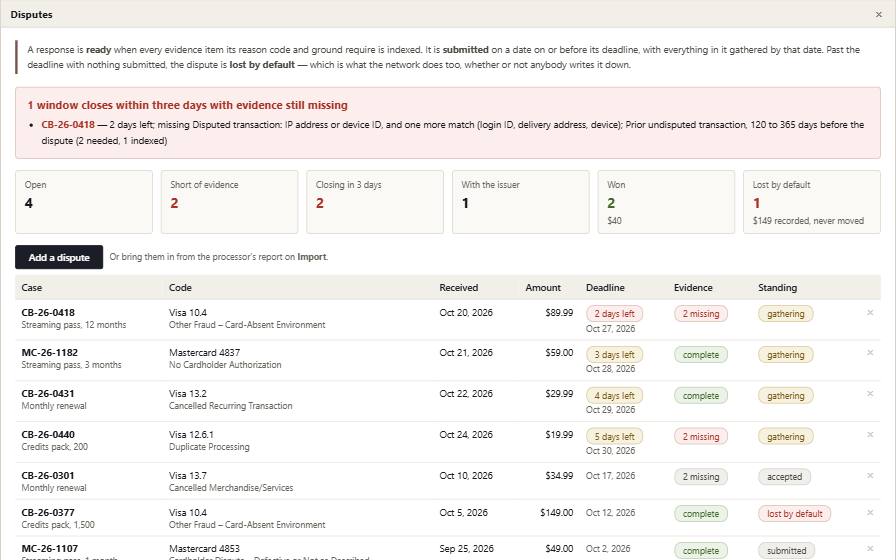
Visa Dispute Management Guidelines →A response cannot be marked ready while any item its reason code and ground require is unindexed. It cannot be recorded as submitted on a date after its deadline, or with evidence gathered after the day it went. Past the deadline with nothing sent, the dispute is recorded as lost by default, with the items that were missing when it shut. There is no override.
How it works
Type one, or read the processor's own exported dispute report into the page. Represent never logs in to your processor — there is no password or key to give it, so there is nothing of yours it could get suspended.
Pick the ground you are answering on and the program lists what it needs. Each item is a type, a description, the date gathered and where it is held — a ticket number, a log export. The files stay in your own systems.
The deadline is the earliest of the network's window, your acquirer's cutoff and the date on the notice, each a dated row you entered. When your processor shortens its cutoff, you add a row from that date, and older disputes keep the deadline they were judged against.
What it will never do
The obvious version of this product connects to your gateway and stores your evidence. That is a credential on the account your business lives on, and a locker full of your customers' purchase histories. Represent is built so it has neither.
Pricing
Because a price that rises with every dispute is a price that makes the next one look not worth fighting.
One descriptor, a handful of disputes a month.
Several descriptors and a steady dispute load.
Multiple merchant accounts and acquirers.
Flat fee, billed monthly. Your bank statement says Represent Software. Your licence key is emailed to you within two working days of payment.
Checkout is our own bitcoin server, not a card processor — nobody we had to apply to and nobody who can close the account. The button takes you straight to it. Give your email address there — that is where your key is sent.
Questions
Because a connection is a stored credential on the account your business depends on, and in this industry that account is the one thing you cannot replace in a week.
Your processor already exports a dispute report. Represent reads that file in the page, on your machine, and nothing leaves it.
Because evidence is your customers' purchase and login history. Holding it would make us the breach.
What loses disputes is not the absence of a file. It is not knowing, on the last day, that the second prior transaction was never pulled — or where the access log went. The index answers that.
No. The deadline is the rows you entered, and the earliest one governs. If your acquirer's cutoff is longer than the row says, correct the row, from the date it changed.
Once a dispute is submitted or lost by default, the dates it was judged on are fixed. A deadline that can be edited after it has passed is not a deadline.
No. Represent works each dispute. Counting disputes against sales, and watching the lines your acquirer measures you against, is Plainwrap's job, and it is a different screen for a different reason.
The Visa grounds follow Visa's own merchant guidelines, condition by condition, and say which page. The Mastercard lists follow a processor's published defence notes, and say that too.
They are a floor, not a guarantee. The issuer decides. Not legal advice.
The demo on this page is the whole program, running on invented records. Paying gets you a licence key — one line of text, emailed to the address you give at checkout within two working days. Paste it into the program and from then on it keeps your own records. Until then, nothing you type into it is kept.
The key is checked inside the page, on your own machine. It never calls us, so there is still no account and nothing about your business goes anywhere. If you ever stop paying, your records stay exactly where they are, read-only, and Export still hands you every one of them.
The demo loads with a Visa fraud dispute two days from its acquirer's cutoff and two items short. Try to mark it ready. Then look at the one that was complete three days too late.