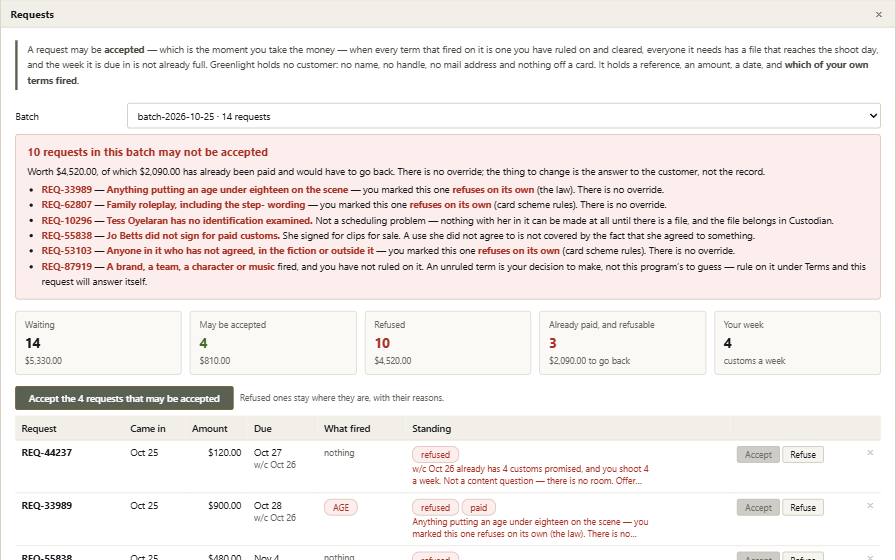
Greenlight screens a custom against your own term list before you accept it — which is the moment you take the money — checks that everyone it needs has a file reaching the day it is due, and refuses a week that is already full. There is no override on either door.
Opens in this browser with a worked example: eight months of requests, the refunds they produced, three customs at the delivery door and fourteen waiting this morning. No account, no email address, nothing installed.
Open the free demo →
The problem
Three ordinary things go wrong, in this order. The paragraph asks for something that cannot be made — sometimes that is the law, more often it is the card scheme's rules, which are shorter, stricter and enforced by taking the merchant account away. The money is already in, so refusing now means owing a refund, and a refund argued about for a month is a dispute counted against the account whatever the merits. And the request needs somebody else, whose file has to reach the day the thing is shot. Each of those is normally handled by remembering to — which means the offer that gets through is the one that was worth the most money.
kinds of refusal, kept apart. Every row in the starting list is marked the law, card scheme rules, a release you would need, or your own line. Everywhere else those are one list, which is how a scheme's rule gets treated as the law and the law gets treated as negotiable.
doors, not one. The first is at acceptance. The second is at delivery — because what gets made is not always what was asked for, and the thing improvised on the day is the thing nobody screened.
words kept. The customer's paragraph is dropped the moment a request is decided; what survives is which of your terms fired. Years of this never become a file of what strangers asked for, indexed by who asked.
A term can be refuses on its own, cleared, or needs your ruling — and the third blocks exactly as hard as the first. The difference is whose move it is: an unruled term is a decision you owe, and the program says so rather than guessing which way you would have gone. Rule on it once, in daylight, and the queue stops asking. A request may not be accepted unless every term that fired has a ruling, nobody it needs is missing a file dated on or before the day it is due, the week it is due in is not already at your own limit, and the date being promised has not already gone.
How it works
Ten rows ship, each marked with where it comes from, and the screen says out loud that they are a guess at a business we do not run. The matcher is twelve lines of whole-word comparison, not a sentence in a prompt — dog finds "dog" and not "doggy", and my wife finds "my wife's name" because a possessive would otherwise glue itself to the word and let the row through.
Every request shows what fired, which door it is stuck at, and the sentence that explains it. Accepting one records the decision and drops the customer's wording in the same act. Refusing one leaves the reasons where anybody can read them later.
A finished custom may not be handed over unless it came in through the first door, everyone in it still had a file reaching the day it was shot, and nothing ended up in it that was not cleared.
The costing screen grades every term against what actually arrived: how many requests it fired on, how many were refused, and what they were worth in money. If the top row is marked the law, that figure is not a decision — it is what the business costs. If it is marked your own line, it is a decision, and now it is one being made with the number in front of it.
What it will never do
The obvious version of this product takes the payment, issues the refund and keeps the conversation. All three are how a vendor ends up owning the risk its customers were trying to get rid of.
Pricing
Because the thing you must never be discouraged from doing is putting one more request through the door.
One creator, one term list, one week's capacity.
Several people taking customs under one policy.
A roster, with somebody else answering the queue.
Flat fee, billed monthly. Never a percentage of what a custom was worth. Your bank statement says Greenlight Software. Your licence key is emailed to you within two working days of payment.
Checkout is our own bitcoin server, not a card processor — nobody we had to apply to and nobody who can close the account. The button takes you straight to it. Give your email address there — that is where your key is sent.
Questions
It does — against the list you wrote. What it will not do is decide a term for you. A term nobody has ruled on blocks the request and says so, because the alternative is a program with opinions of its own about what you are willing to make.
The test suite's sharpest assertion is exactly that pair: an unruled term blocks a request, and changing the ruling on the Terms screen clears that same request.
Because it fires on half of everything and means nothing about family. The reason is written on the row rather than left out, so nobody adds it back by accident.
A list that cries wolf gets switched off, and a switched-off list protects nobody. The same argument is why the matcher is whole-word: a substring search somebody wrote in a hurry would flag far more and be trusted far less.
Which terms fired is enough to explain any decision for as long as anybody asks, and it is the half that does not accumulate into a liability. The paragraph is the half that does.
Two years of kept paragraphs is a file of what strangers asked an adult business for. There is no version of holding that which is safer than not holding it.
Because the request that overfills a week is the one that paid the most, and it arrives on a Thursday. The rule exists so the answer is already written down before the money is attached.
In the worked example one request has nothing wrong with it at all and is refused anyway, because next week is already at the number the operator said they could shoot. That row is in there on purpose.
No. The rows marked the law are a prompt to take advice, not the advice, and the screen says so. The list ships as something to argue with.
What Greenlight guarantees is that the list you settled on was applied identically to every request on every day, and that the money was never taken before the screen ran.
The demo on this page is the whole program, running on invented records. Paying gets you a licence key — one line of text, emailed to the address you give at checkout within two working days. Paste it into the program and from then on it keeps your own records. Until then, nothing you type into it is kept.
The key is checked inside the page, on your own machine. It never calls us, so there is still no account and nothing about your business goes anywhere. If you ever stop paying, your records stay exactly where they are, read-only, and Export still hands you every one of them.
The highest-paying request in the batch cannot be made at all, and the money for it is already in. One needs Tess, who has no file. One needs Jo, who signed for clips and not for customs. One is clean and refused anyway because next week is full. Two are waiting on the operator rather than the customer. Then look at the delivery door, where one custom picked up something on the day that nobody asked for.