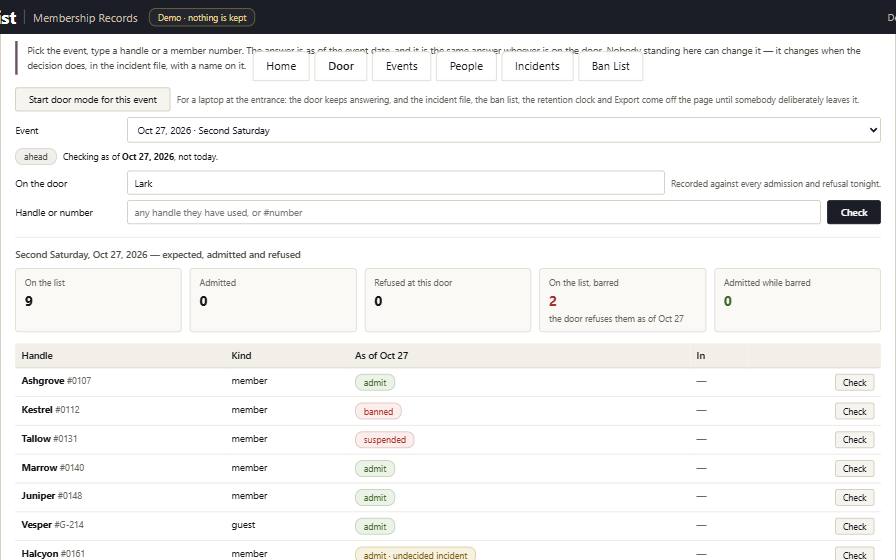
Doorlist is the ban list the door cannot argue with, the incident file that outlives whoever was working, and a retention clock on both. Every answer is given as of the event date, and it is the same answer whoever is holding the clipboard.
Opens in this browser with an invented organisation already in it. No account, no email address, nothing installed, and no photograph anywhere.
Open the free demo →
The problem
Something happens at an event. Two people deal with it, verbally, that night. A few months later the same person is back at the door — on a night when the two who knew are not working. Nobody decided anything wrong. Nobody decided anything on paper, and the door cannot refuse what nobody told it.
kinky people surveyed by the National Coalition for Sexual Freedom had pre-negotiated limits violated or a safeword ignored — typically in their first five years in the scene. The pattern is the thing a door log exists to see. Doorlist is not affiliated with, endorsed by or sponsored by the National Coalition for Sexual Freedom, the Center for Positive Sexuality, Magpie Kink or KinkFest. Their published materials are cited here for context only.
Center for Positive Sexuality, on the NCSF survey →There is no certification to be an event organiser or venue in this community, and quality varies. The standard an organisation keeps is whatever it writes down and enforces.
Magpie Kink →One large convention bans photos and recordings unless an area is marked, and requires tape over every camera lens in common areas. A photograph is the record this community will not tolerate — so it is the record this program has nowhere to put.
KinkFest 2026 Code of Conduct →Anybody under a ban or suspension in force on the event date is refused at check-in, with the reason, the incident, and the name of whoever decided it — looked up by any handle they have ever used. There is no override button: an override is a button somebody presses at the end of a long night. And an incident cannot be closed without a written decision and a named decider, so the door never acts on a rumour either.
How it works
An incident is a written account, a decision — ban, suspension with an end date, warning, or no action — the reasoning, and the person who made it. The program records the day it was decided and the day it was written down, because the gap between the two is where people get back in.
Pick the event, type a handle or member number. Admitted or refused, with the reason, as of that night. A suspension that ended last week admits somebody on Saturday; one that runs through next week refuses them. Every refusal is logged against the event.
Each kind of decision carries its own retention period, set by you. Past it, the record is flagged to go. Inside it, it cannot be removed at all. A ban never lapses on a timer — it comes up for review, and a review is a decision with a name on it.
What it will never do
A face, attached to a handle, attached to this kind of event, is the single most dangerous record an organiser could hold. It is what a breach takes and what outs somebody to an employer. The promise that it does not exist is worth more than any door it would make faster.
Pricing
Because the thing you must never be discouraged from doing is writing an incident down.
A single recurring event with one door.
Every event the organisation runs, every door.
A venue hosting several organisations, each with its own file.
Flat fee, billed monthly, cancel whenever. Never per head, never per ticket, never a percentage. Paid in bitcoin through our own payment server, so nothing appears on a bank or card statement at all — your receipt and your licence key go to the email address you give at checkout. Doorlist is sold by FHL Stephens LLC, an Oregon limited liability company, 1303 SE Stephens St, Roseburg, OR 97470 · sales@callboardsoftware.com. Your licence key is emailed to you within two working days of payment.
Checkout is our own bitcoin server, not a card processor — nobody we had to apply to and nobody who can close the account. The button takes you straight to it. Give your email address there — that is where your key is sent.
Questions
Then you have a list without a history. It cannot tell the person on the door whether a suspension has ended, who decided it, or that the handle in front of them is a new one for somebody already on it.
Doorlist can, as of the date of the event, and it says so the same way whoever is asking.
No, and deliberately. There is no override button anywhere in the program.
A ban or suspension changes through a review in the incident file — dated, reasoned, and signed by whoever made it. The door is never where a decision gets made, which is also what protects the person on it.
It would, by a few seconds. It would also make this file the most dangerous thing your organisation owns.
People are known by handle and number because that is how they are known in the room. We would rather lose the sale than hold that picture.
Long enough to see a pattern, and no longer than you can justify. Doorlist holds a period per kind of decision — you set it — and refuses to delete anything early.
Where data-protection law applies to you, it asks that personal data be kept no longer than necessary for its purpose. This is not legal advice, and the periods on screen are the ones you typed.
The demo on this page is the whole program, running on invented records. Paying gets you a licence key — one line of text, emailed to the address you give at checkout within two working days. Paste it into the program and from then on it keeps your own records. Until then, nothing you type into it is kept.
The key is checked inside the page, on your own machine. It never calls us, so there is still no account and nothing about your business goes anywhere. If you ever stop paying, your records stay exactly where they are, read-only, and Export still hands you every one of them.
The next event in the demo is two days away. Two people on its list are refused at check-in, one of them under a handle she has not used here in years. Last month somebody was let in while suspended, because the decision was agreed on the phone and not written down for four weeks. Try to let either of them in.