Custodian Records Index
For studios and producers

An inspection is not “do you have the paperwork.” It is an agent naming a title, and a clock starting.

No advance notice, no requirement of suspicion. Custodian is the index that answers in seconds — every performer, every name they were credited under, and the identification that governed on that date.

Opens in this browser with a worked example catalogue already in it. No account, no email address, nothing installed.

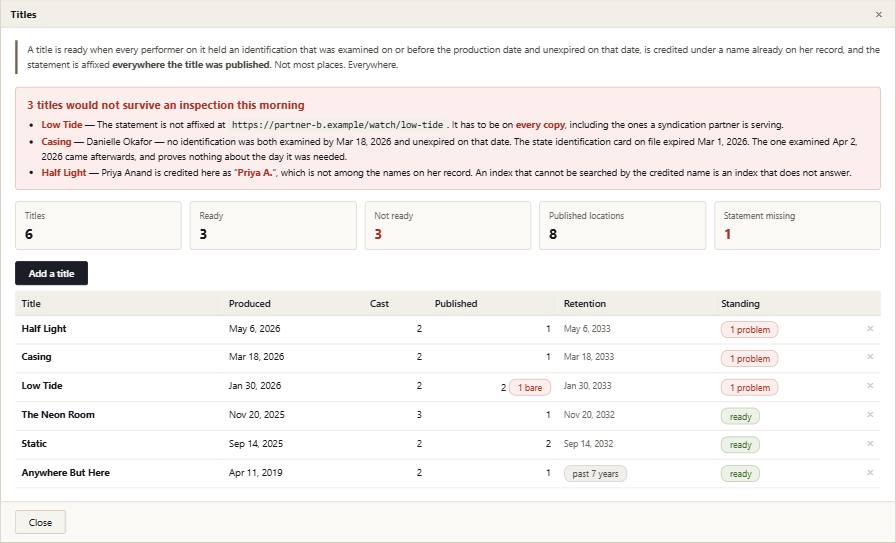
Custodian with its example records in itOpen the free demo →

The problem

Studios do not fail at collecting. They fail at indexing.

The records exist, in a drawer, in a folder per shoot, organised by date, because that is how they were made. The statute wants them retrievable by performer and by every name that performer has ever used — and the statement tied to every URL the title was published to, including the syndication partner nobody has thought about in three years.

7 years

retention from production, and five more after the producer goes out of business. A title inside the window whose records were thrown out is the same failure as never having made them.

18 U.S.C. § 2257 →
No notice

Inspection is on demand during business hours, with no advance warning and no requirement of suspicion. There is no version of this you can revise for on the day.

EFF Internet Law Treatise →
Every copy

The statement saying where the records are held must be affixed to every copy of the matter produced. Every mirror, every partner, every URL you have forgotten about.

Cornell LII →

The index is what fails an inspection. The hoard is what fails a breach.

The statute requires you to hold a copy of the identification, so no program can refuse the document and call that compliance — and this one does not pretend to. What Custodian refuses is to be the hoard. It records that an identification was examined, of what type, expiring when, by whom, on what date, and where the copy is held. There is no field for an identification number and no way to attach an image. A number adds nothing to an index and everything to a breach.

How it works

Every question is asked as of the production date

Record the examination

Type, expiry, examiner, date, and where the copy is kept — which should be offline, encrypted, in the custodian's own possession, exactly where the statute contemplates it. An identification is a history, not a field: which one governs a title depends entirely on when that title was produced.

Index every name

Legal name, stage name, the shortening, the spelling a partner site used once. A record filed under one name and credited under another is a record that does not exist — and that is the finding studios are most often surprised by.

Run the drill

A button that says an agent is at the counter. It picks a title at random and starts a clock. If you say you have the binder, the program checks — because the belief that the paperwork is fine is not the same as the paperwork being fine.

What it will never do

No images. No numbers. Nowhere to put them.

An identification library is the most dangerous asset anybody in this industry can own. It is what a breach takes, what a subpoena reaches, and what turns one bad Tuesday into every performer on your roster being outed under their legal name.

No images. Not one byte.No scans, no photographs of documents, no thumbnails, no media of any kind. There is nowhere in the program to put one, which is a stronger promise than a policy saying we would not look.
No identification numbers.Type, expiry, examiner, date, location. A number would make the index no better and a breach far worse.
We do not become your custodian of records.That is a role with premises, staffed hours and legal exposure — a service business, not a software one. Taking it would put us inside the content chain, which is the one place this company will not go.
Flat fee. Never per title, never per performer.Pricing that rises with your roster is pricing that discourages recording somebody, and this is the one program where an unrecorded performer is the catastrophic outcome.
Pricing

Priced per studio, not per title

Because the thing you must never be discouraged from doing is adding another performer to the index.

Library

$199/month

A back catalogue still in distribution, with no active production.

  • Full title and performer index
  • Alias cross-reference
  • URL and statement tracking
  • Retention clock per title
  • The inspection drill
Most studios

Studio

$399/month

Active production, up to 250 titles.

  • Everything in Library
  • Identification examinations as a dated history
  • Readiness computed as of each production date
  • Publication gate on titles that are not ready
  • Custodian designation and statement text

Studio, large

$899/month

Unlimited titles and unlimited performers.

  • Everything in Studio
  • Unlimited titles and roster
  • Drill history and timings
  • Priority support

Flat fee, billed monthly. Your bank statement says Custodian Software. Your licence key is emailed to you within two working days of payment.

Checkout is our own bitcoin server, not a card processor — nobody we had to apply to and nobody who can close the account. The button takes you straight to it. Give your email address there — that is where your key is sent.

Questions

The ones we actually get asked

We already have a system. The records are in the safe.

Good, and they should stay there. Custodian does not want them and has nowhere to put them.

The question is not whether the records exist. It is whether, when somebody names a title, you can produce every performer on it under every name they were credited as, with the identification that governed that date rather than the one that is current now, and the statement affixed at every URL including the partner's.

The safe answers none of those in the time you have. It is storage. This is the index.

Does it actually stop us publishing?

Yes. A title that is not inspection-ready cannot record a new publication in the program.

Publishing is the act that creates the obligation, so that is where the door belongs — and a door you can walk around is a sign, not a door.

What if a performer used a name we did not know about?

Then the title reads as not ready, and it names her and the credit that is not on her record.

That is the single most common real-world failure in this area and almost nothing else surfaces it, because a folder organised by shoot date cannot be searched by a name nobody wrote down.

Is a title past seven years safe to destroy?

Not necessarily, and the program is careful to say so rather than showing you a shredder schedule.

The five-year tail after a business closes runs from the closing, not from production, and a title still in distribution is still being produced as far as anybody asking is concerned. The retention column is a prompt to take advice.

What do I actually get when I pay?

The demo on this page is the whole program, running on invented records. Paying gets you a licence key — one line of text, emailed to the address you give at checkout within two working days. Paste it into the program and from then on it keeps your own records. Until then, nothing you type into it is kept.

The key is checked inside the page, on your own machine. It never calls us, so there is still no account and nothing about your business goes anywhere. If you ever stop paying, your records stay exactly where they are, read-only, and Export still hands you every one of them.

Press the button and find out

Open the demo, go to Inspection, and let it name a title. Three of the six in there are ready. Three are not, each for a different reason, and one of them is the reason most studios fail.