Turnstile Order Decisions
For site operators taking cards

The account does not close over one bad order. It closes over a ratio nobody computed.

Turnstile holds your own risk policy as rows with points on them, applies it the same way to every order, and computes each network's dispute ratio on that network's denominator. It is not in the authorisation path, takes no money, and has no field for a card number, a name or an address.

Opens in this browser with a worked example operator, twenty months of history and fifteen orders waiting this morning. No account, no email address, nothing installed.

Turnstile with its example records in itOpen the free demo →

The problem

Nobody decides to run a bad month. The statement just arrives three weeks after it closed.

The checks already exist — address verification, velocity, funding type, your own refusal list. What is missing is a price on each of them that does not change depending on who is on shift. And the ratio itself is harder than it looks: one network counts this month's disputes against this month's sales, another against last month's, so a month that grew reads safer under one than the other. By the time the acquirer's letter arrives, the month it is about is two months old and nothing can be done to it.

3.9×

What the demo's retried-security-code factor is actually worth, measured on the orders that came back — against the 20 points somebody guessed for it. The grading screen finds this from outcomes; it is not told.

Visa — Dispute management guidelines for merchants →
0.6×

What its proxy-detection factor is worth. It fires on a sixth of all orders and predicts nothing — so every order it refuses is revenue, measured, and a factor that costs money is worth finding.

two

denominators. A dispute ratio measured against this month's sales and against last month's are different numbers, and the same month can be under one line and over the other. Turnstile computes each programme on its own basis and never blends them into one figure, because there is no such line to be under.

Mastercard — Chargeback guide →

The door is at the order, not at the statement.

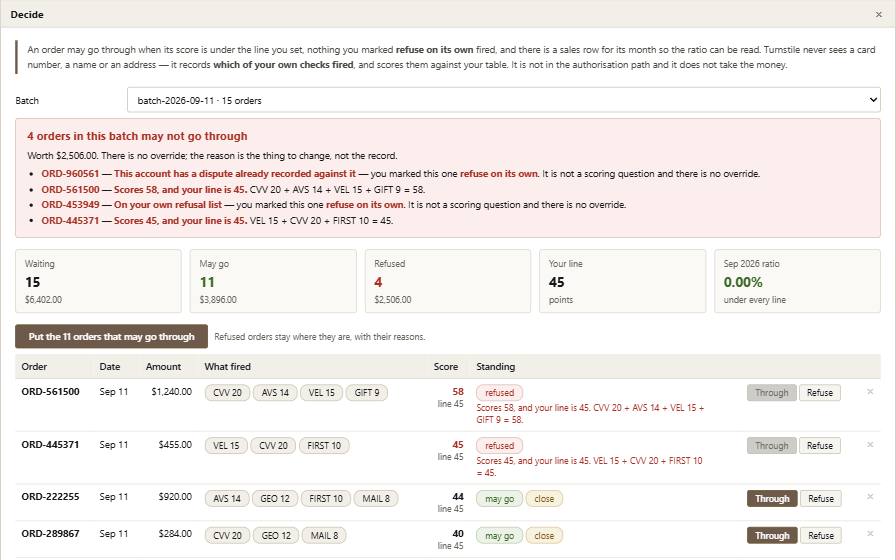
An order cannot be marked through unless its score is under your line — at or above it is refused — nothing you marked refuse on its own fired, every code that fired has a row that prices it, and there is a sales row for its month so a ratio has a denominator. In a month already over a line, an order with anything on it waits. There is no override.

How it works

Your policy, written down and applied the same way every time

Price your own factors

Ten rows to start with, and the screen says out loud that the weights are our guess at a business we do not run. Each row is a result your own checks report — AVS fired, never what the address was. Setting the line writes it with today's date, so an order is always judged against the line in force on its date.

Decide the queue

Every order shows what fired, what it scores, which side of the line it is on and the sentence that explains it. Refused orders stay where they are with their reasons. Marking one through records a decision — your gateway does the sending, exactly as it does now.

Read the month the way the network reads it

Enter the processor's sales count and every programme row computes its own ratio, on its own denominator, against its own count and ratio lines. Then the grading screen measures your table against what actually came back: which factors earned their points, and which are costing you sales.

What it will never do

It is not in the authorisation path, and never will be.

The obvious version of this product sits in the payment flow and holds cardholder data. Both are how a vendor ends up owning the risk its customers were trying to get rid of.

It cannot approve or decline a card.Not a gateway, not a processor, not a step in authorisation. It records a decision about an order so there is a record of why. Nothing here can stop a charge, and nothing here can cause one.
It holds no cardholder data.No card number — masked, truncated or hashed. No name, no billing address, no mail address, no IP address, no device fingerprint. A factor is a result your own system reported. A vendor holding cardholder data beside adult purchase history has built something worth stealing.
It is not a fraud model.It never sees a raw signal, so it cannot score an order by itself and does not pretend to. It holds the policy you wrote and does the arithmetic the same way every time.
It is not a dispute desk.It counts a chargeback. The evidence, the deadline and the representment are a different job, and bolting them on here is how both get done badly.
Flat fee. Never a percentage of approved volume.A vendor paid on what gets through has an interest in the gate being open. Ours does not move when you have a good month.
Pricing

Priced per operator, not per order

Because the thing you must never be discouraged from doing is putting another order through the gate.

One site

$149/month

One property, one processor, one line.

  • Your factor table, with a line that has a history
  • The gate on every order, with no override
  • Monthly ratios on each programme's own denominator
  • Exposure: what went through that would be refused now
  • No card number, name or address stored anywhere
Most operators

Operator

$349/month

Any number of properties, several processors.

  • Everything in One site
  • Unlimited programme rows, including your acquirer's own line
  • Disputes recorded against the order that produced them
  • The grading screen: every factor measured on what came back
  • Part-month readings, stated as part-month

Portfolio

$699/month

A group of brands under one risk policy.

  • Everything in Operator
  • Unlimited factors and lines
  • Each new month flagged before the first order dated in it
  • Priority support

Flat fee, billed monthly. Never a percentage of approved volume or of anything that comes back. Your bank statement says Turnstile Software. Your licence key is emailed to you within two working days of payment.

Checkout is our own bitcoin server, not a card processor — nobody we had to apply to and nobody who can close the account. The button takes you straight to it. Give your email address there — that is where your key is sent.

Questions

The ones we actually get asked

Can it just decline the bad orders for us?

No, and it never will. The day Turnstile sat in the authorisation path it would be a payment system, with your chargeback exposure and your PCI scope attached to it, and you would be buying your risk back from a vendor instead of getting rid of it.

It holds the policy and does the arithmetic. Marking an order through or refused is a record of a decision; your gateway and your own rules do the deciding, exactly as they do now.

How can it score an order without seeing anything about the order?

It scores what your checks reported. Address verification came back a mismatch; this was the third attempt tonight; the funding instrument is prepaid. Those are results, and a result is all a policy needs.

There is no field here for an address, a mail address, an IP address or anything off a card, and there will not be one. What that costs you is that Turnstile cannot invent a signal you do not already have. What it buys you is that there is nothing here to steal.

Why does an order scoring exactly the line get refused?

Because the line is "refuse at or above", and an off-by-one in a gate has to err in the direction that costs an order rather than the direction that costs the account.

If you want 45 to go through, your line is 46. Writing it down that way is the whole point — a line that means something slightly different depending on who reads it is not a line.

Our ratio has never been near a network programme. Why would we need this?

Because at ordinary volume a network programme is almost unreachable — the hundred-dispute condition means you would need a catastrophic ratio to trip it. The line that closes accounts in this sector is the one in your own acquirer agreement, which is tighter, has no count condition, and is usually the one nobody has written down.

The demo ships that row third, deliberately, and its August is over it while both network programmes are still under.

Is this advice about our risk policy?

No. The factor weights it ships with are a guess at a business we do not run, and the program says so on the screen. Every programme threshold is what you entered, with where you read it and the date.

What Turnstile does is apply your policy identically to every order on every day, and then measure it against what came back. That is the part software is good at, and the part a person quietly stops doing in a busy week.

What do I actually get when I pay?

The demo on this page is the whole program, running on invented records. Paying gets you a licence key — one line of text, emailed to the address you give at checkout within two working days. Paste it into the program and from then on it keeps your own records. Until then, nothing you type into it is kept.

The key is checked inside the page, on your own machine. It never calls us, so there is still no account and nothing about your business goes anywhere. If you ever stop paying, your records stay exactly where they are, read-only, and Export still hands you every one of them.

Open the demo and try to clear the batch

Fifteen orders are waiting. Eleven may go. Four may not — one over the line on points, one sitting exactly on it, and two carrying a factor the operator marked refuse-on-its-own. Then look at August: 1.46%, over the acquirer's line and over the network's fraud line, and under the one everybody watches.