Treaty Withholding Register
For platforms paying performers outside the US

A W-8 signed in 2022 stopped working on the last day of 2025. The payouts did not.

Treaty reads your payout file and tells you, payout by payout, what may go at what rate — and refuses any payout to somebody abroad at a reduced or zero rate unless a form valid on that payout’s date supports it.

Opens in this browser with a worked example platform already in it. No account, no email address, nothing installed.

Treaty with its example records in itOpen the free demo →

The problem

Nobody decides not to withhold. A form just quietly expires.

Pay somebody outside the United States and you are a withholding agent. The default on US-source income is thirty percent of the gross. A treaty can take that to ten, five or nothing — on the strength of a form that has a shelf life, has to claim the right country and article, and has to have been in your hands before the money went. A folder of PDFs answers none of that for a given date.

30%

the default rate on US-source royalties and other fixed or periodical income paid to a foreign person, on the gross. A treaty rate is available only where the paperwork supports it.

IRS — FDAP income →
Liable

The withholding agent is personally liable for tax it was required to withhold. Under-withhold, and the shortfall is the platform’s money, not the payee’s.

IRS — Instructions for Form 1042 →
3 years

A W-8BEN is generally good from signing until the last day of the third calendar year after it — sooner if a change in circumstances makes it wrong. Every form on your books is counting down.

IRS — Instructions for Form W-8BEN →

The door is the rate, and it is locked by date.

A payout to a payee outside the US cannot be cleared at a reduced or zero rate unless a W-8 valid as of the payout date supports it — the right form for an individual or an entity, signed and in hand by then, unexpired, with a TIN recorded as provided and the treaty country and article on it. Where the form is missing, expired or claims less than the treaty gives, Treaty computes the default withholding and refuses the lower rate. There is no override button. The way past the door is to withhold, or to get the form.

How it works

Every payment classified, every question asked as of its date

Record the form, not the number

Form type, signed date, the date it reached you, the treaty country, article and rate claimed, whether a US or foreign TIN was provided, and where the form itself is kept. Never the TIN. A form is a history, not a field: which one governs a payout depends on when the payout was made.

Classify the payment

A royalty is sourced where the work is used, so only the share used in the US is US-source — Treaty takes that share from your audience report rather than assuming it. Pay for services is sourced where the services were performed: performed abroad it is foreign-source, performed in the US it needs a Form 8233, not a W-8BEN. The classification is on every screen.

Read the file, clear what may go, reconcile in March

Paste the payout file. Treaty holds every line the documentation does not support, says why in one sentence, and computes what must be withheld. Cleared lines become a release list for whatever actually pays. At year end it sets what you withheld against every 1042-S, recipient by recipient and income code by income code, before the 1042 goes in on March 15.

What it will never do

It never moves money. It never holds a TIN.

A register that holds tax identification numbers for every payee abroad is a breach waiting for a date. A register that moves money is a money transmitter. Treaty is neither, by construction.

It never moves money.Treaty reads the payout file and says what may go and what must be withheld. It is not a payout rail, not an escrow and not a money transmitter. The moment it touched funds it would join the risk category it exists to keep you out of.
No TINs. US or foreign.It records that a TIN was provided and which kind, on which form, signed when, and where the form is kept. There is no field anywhere for the number itself.
US payees are not its business.Treaty handles payees outside the United States. A payee recorded as a US person is out of scope, and Treaty will not clear a payout to one — W-9, backup withholding and 1099 belong to Docket.
Flat fee. Never a percentage.No media, no stored credentials, and a price that does not move with what you pay out. A vendor paid a slice of creator earnings has an interest in them.
Pricing

Priced per platform, not per payee

Because the thing you must never be discouraged from doing is collecting one more form.

Roster

$250/month

An agency or small platform, up to 100 payees abroad.

  • W-8BEN and W-8BEN-E as a dated history
  • The rate gate on every payout
  • Payment classification and US-share sourcing
  • Your own treaty rate table
  • Release list for your payout rail
Most platforms

Platform

$500/month

Up to 2,500 payees abroad, monthly payout files.

  • Everything in Roster
  • Payout file reading
  • Form 8233 for US services, by tax year
  • Chapter 4 status on entity forms
  • Under-withheld ledger
  • 1042-S reconciled to what you withheld

Platform, large

$1,100/month

Unlimited payees, weekly or daily payout files.

  • Everything in Platform
  • Unlimited payees
  • Form expiry chase list
  • Priority support

Flat fee, billed monthly, cancel whenever. Never a percentage of anything you pay out. Your bank statement says Treaty Software. Your licence key is emailed to you within two working days of payment.

Checkout is our own bitcoin server, not a card processor — nobody we had to apply to and nobody who can close the account. The button takes you straight to it. Give your email address there — that is where your key is sent.

Questions

The ones we actually get asked

Our payout provider already collects W-8s.

Good. Keep them there. Treaty does not want the forms or the numbers on them.

The question is not whether a form exists. It is whether the form that existed on the day this payout went supported the rate it went at — signed and received by then, not yet expired, claiming this country and this article, for this kind of income. Collection answers the first. Nothing answers the second except asking it payout by payout, by date.

Is creator income a royalty or pay for services?

It depends on the arrangement, and it changes the answer completely. Royalties are sourced where the work is used, so the US-viewed share is US-source and subject to withholding. Pay for services performed outside the US is foreign-source and is not.

Treaty does not decide that for you. It makes you classify every payment, states the rule that follows on screen, and applies it consistently. Take advice on the classification; Treaty makes sure it is applied.

What happens without a valid form?

On a US-source royalty, nothing reduces the rate: Treaty computes the unreduced 30% on the US share and refuses anything lower.

On foreign-source services, the zero is only available once the payee is documented as foreign. Without that, a payment that cannot be tied to documentation is presumed made to a US person, so Treaty holds backup withholding and hands the payee to Docket until a W-8 arrives.

Where do the treaty rates come from?

From you. Treaty ships a starting table transcribed from the IRS’s own treaty table, and every screen that shows it says it is what the operator entered. The IRS says its table is not a complete guide to every treaty, and neither is ours.

Not tax advice. Treaty holds what you tell it and applies it the same way to every payout on every date, which is the part software is good at.

What does the March check actually check?

Every recipient abroad with US-source income gets a 1042-S, even where a treaty took the withholding to zero, and the 1042 totals them. Treaty sets the gross and the tax on each 1042-S — typed in from your filing vendor’s forms — against what the register says went and what was withheld from it.

A missing 1042-S, a box 7a claiming tax that was never withheld, a royalty reported whole when only its US share was US-source, a shortfall the platform paid from its own funds that is not in box 11: each is a finding with the recipient’s name on it. Treaty files nothing and holds no TIN to file with.

Does it cover DAC7?

No. Europe’s DAC7 has platform operators report what their EU sellers earned, including for personal services, and it reaches platforms outside the EU. It is a reporting duty that sits alongside US withholding rather than replacing it. Treaty keeps the US side; note the other one exists.

What do I actually get when I pay?

The demo on this page is the whole program, running on invented records. Paying gets you a licence key — one line of text, emailed to the address you give at checkout within two working days. Paste it into the program and from then on it keeps your own records. Until then, nothing you type into it is kept.

The key is checked inside the page, on your own machine. It never calls us, so there is still no account and nothing about your business goes anywhere. If you ever stop paying, your records stay exactly where they are, read-only, and Export still hands you every one of them.

Open the demo and read this month’s file

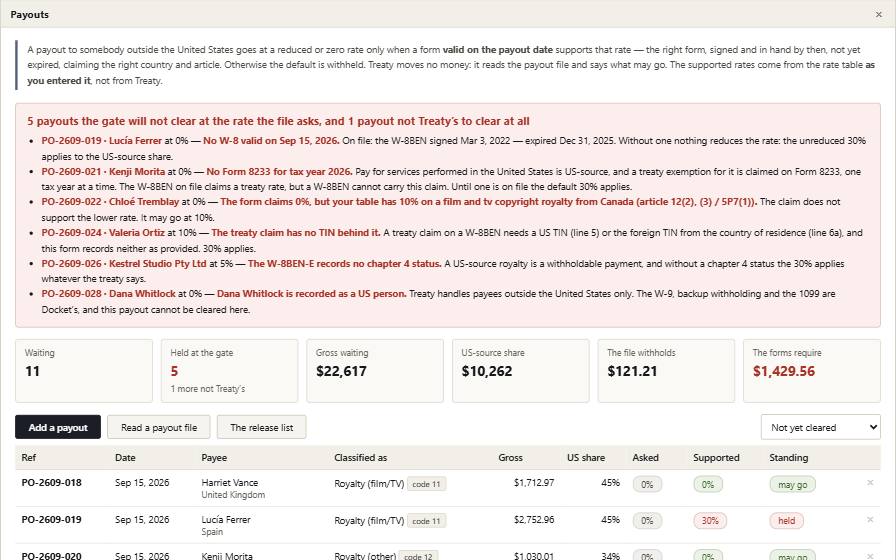
Eleven payouts are waiting. Five may go. Five are held, each for a different reason — an expired form, a claim for the wrong kind of royalty, a claim with no TIN behind it, an entity with no chapter 4 status, a US appearance on the wrong form — and one belongs to a US person, which is not Treaty’s at all. Then open Year end: last year’s 1042-S figures have two findings against the register.