Syndicate is the register of every grant you have made — titles, territories, formats, window, exclusivity — and a door that will not issue a grant that lands on ground already sold. It names the grant it collides with.
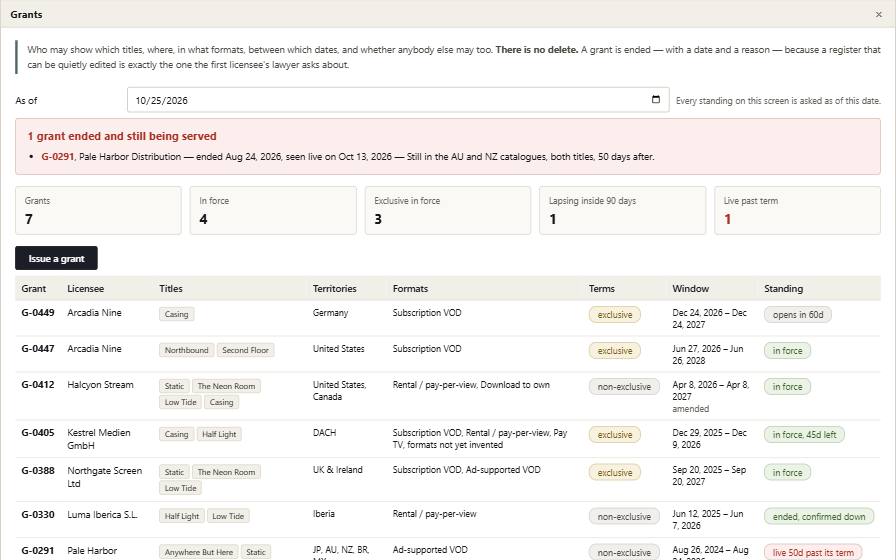
Opens in this browser with an invented catalogue already in it, and a draft on the desk that collides. No account, no email address, nothing installed.
Open the free demo →
The problem
Rights go out territory by territory and format by format, for a window, to a network, an aggregator, a regional partner. Two things then happen, and neither shows up in the folder. An exclusive is granted over ground that was already inside an earlier one — a breach of the first contract, found by the first licensee. And a term ends while the titles stay up, which leaves the owner as the party whose paperwork says something is licensed when it is not.
In US copyright law an exclusive licence is a transfer of ownership, whether or not it is limited in time or place. A second exclusive over the same ground is conveying something you have already conveyed.
17 U.S.C. § 101 →Between two conflicting transfers, the one executed first generally prevails if it is recorded in time — and a written non-exclusive taken earlier survives a later transfer too. Somebody paid for ground they do not get, and they find out from each other.
17 U.S.C. § 205(d)–(e) →per work: the ceiling on statutory damages for wilful infringement, and $750 to $30,000 per work otherwise. A partner still serving a catalogue after its term is serving it without a licence, and the count is title by title.
17 U.S.C. § 504(c) →Overlap is the intersection of four things — titles, territories, formats and dates — where either grant is exclusive. Two non-exclusives can share ground. An exclusive cannot share it with anybody, and a non-exclusive into an exclusive's ground is refused the same way. The question is asked as of the day the new grant is signed, and extending a grant goes through the same door. There is no override. If the earlier grant really ended early, record that on it, with the date it was agreed, and the answer changes by itself.
How it works
Titles, territories, formats and the treatment of formats not yet invented, exclusivity, window, licensee and the owner's share. A grant is a history, not a field: its end date and its share each move by amendment, with a date and a reason, and there is no delete.
A draft waits on the desk until it is issued. Issuing checks it against every grant on the register as it stood on the signing date. A collision is refused, the collider is named with the exact ground both would cover, and the attempt goes into a log nobody can clear.
The expiry board sorts every grant by what lapses next, and asks of every one that has ended whether anybody saw it come down. Royalty statements are reconciled by deriving the share each one actually paid and measuring it against the share the grant called for on that date.
What it will never do
A rights register is only safe to keep if there is nothing in it a thief would want. So there is nothing in this one but the shape of the paperwork.
Pricing
Because the thing you must never be discouraged from doing is writing another grant down.
A finished catalogue and a handful of licensees.
An active licensing desk, up to 500 titles.
Unlimited titles, territories and licensees.
Flat fee, billed monthly. Never a percentage of your royalties. Your bank statement says Syndicate Software. Your licence key is emailed to you within two working days of payment.
Checkout is our own bitcoin server, not a card processor — nobody we had to apply to and nobody who can close the account. The button takes you straight to it. Give your email address there — that is where your key is sent.
Questions
Good. The drafting is not the problem, and Syndicate does not want the contracts.
The question is whether, on the day somebody offers you money for German subscription rights on three titles, you can say in seconds whether any of that ground was already sold — to whom, until when, and whether the grant that sold it was extended last spring.
A folder answers none of that without somebody reading every document in it. The register answers it before you sign.
Yes. A colliding grant is refused, and the grant it collides with is named, with the exact titles, territories, formats and dates both would cover.
There is no override. An override is a button somebody presses at five o'clock on a Friday. If the earlier grant really has ended early, you record that on it with the date it was agreed, and the answer changes because the facts did.
A grant can claim them. Two grants that both claim formats not yet invented both claim the next one, so they collide on it, and the program says so.
A grant that lists only named formats collides only on those.
It tells you what the record says, and it never assumes. It never visits their service — you record what you saw, and when.
An ended grant is only treated as down if somebody saw it come down after the end date. A statement reporting revenue for a period after the end date is treated as the licensee telling you it did not.
No, and it never will. It records what each statement said, derives the share actually paid, and measures that against the share the grant called for on that date.
A share that quietly moved while the contract did not is marked on the row. Nothing is invoiced, collected, held or paid.
The demo on this page is the whole program, running on invented records. Paying gets you a licence key — one line of text, emailed to the address you give at checkout within two working days. Paste it into the program and from then on it keeps your own records. Until then, nothing you type into it is kept.
The key is checked inside the page, on your own machine. It never calls us, so there is still no account and nothing about your business goes anywhere. If you ever stop paying, your records stay exactly where they are, read-only, and Export still hands you every one of them.
The demo has three drafts waiting. Two collide with grants already on the register — one an exclusive onto an exclusive, one a small non-exclusive into somebody else's exclusive — and the program names both colliders. The third goes through. On the expiry board, one grant ended two months ago and is still being served.