Stub keeps each night’s cover charges and private-dance fees apart from everything else, applies New York’s admissions rule — including when a stage-only exemption cannot be claimed — and builds an audit-ready schedule by night that will not sign while a night is missing or short of tax without a reason.
Opens in this browser with an invented club already in it. No account, no email address, nothing installed.
Open the free demo →
The problem
New York taxes admission to a place of amusement unless it is to a dramatic or musical arts performance. A club argued its dancers were exactly that; the state’s top court disagreed 4–3, with about $400,000 at stake. A later audit of the same club found its stage could qualify — but the door charge, which customers had to pay before buying private dances, stayed taxable, and so did the private dances.
New York’s Court of Appeals held in 2012 that a club’s dances were not exempt dramatic or musical arts performances, so the admission was taxable.
Matter of 677 New Loudon Corp. →about what the club faced in its sales tax audit, as reported at the time.
Don’t Mess With Taxes →In the follow-up audit the stage show could qualify, but a door charge required before private dances, and the private dances, stayed taxable.
NYSSCPA →Not a reminder. Sign the schedule refuses, with the nights listed, while any open night is not written down or any night collected less tax than was due with no note saying why — or the quarter has not ended. A stage-only exempt amount is refused unless Settings records that the door buys nothing but the stage show. There is no override.
How it works
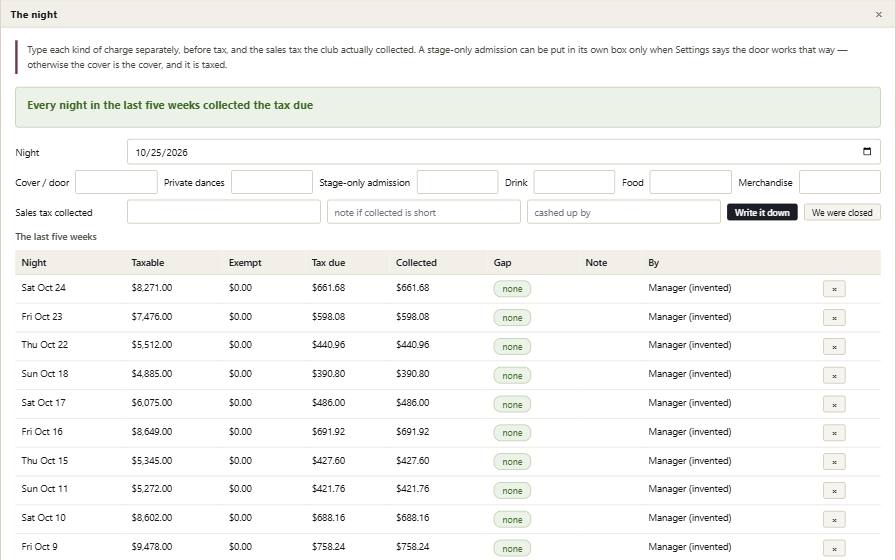
Cover, private dances, drink, food, merchandise — each before tax — and the sales tax actually collected. Stub shows the tax due and any gap at once.
A night that collected less than was due needs a note: why, and who is paying it. A gap with no note stops the quarter.
The quarter’s nights, every charge, the tax due and collected, signed and frozen — the backing an auditor asks for.
What it will never do
Amounts by kind per night, and the tax on them, is all an admissions schedule needs.
Pricing
Four quarters, one price.
One club, billed yearly.
One club, several managers cashing up.
Several clubs under one owner, billed yearly.
Flat fee, billed yearly. Never a share of takings. Your bank statement says Stub Software. Your licence key is emailed to you within two working days of payment.
Checkout is our own bitcoin server, not a card processor — nobody we had to apply to and nobody who can close the account. The button takes you straight to it. Give your email address there — that is where your key is sent.
Questions
As an admission to a place of amusement, yes, unless it is solely for a dramatic or musical arts performance. Where the cover lets customers buy private dances, the follow-up audit of the club in the 2012 case found it was not solely for a performance.
In that audit, yes. Stub treats them as taxable.
Possibly, for an admission that buys nothing but a stage show that qualifies. Stub lets you record it only after you say, in Settings, why it qualifies. Ask your adviser first.
No. It is a schedule that argues with you. The Department of Taxation and Finance and your adviser are the authority.
The demo on this page is the whole program, running on invented records. Paying gets you a licence key — one line of text, emailed to the address you give at checkout within two working days. Paste it into the program and from then on it keeps your own records. Until then, nothing you type into it is kept.
The key is checked inside the page, on your own machine. It never calls us, so there is still no account and nothing about your business goes anywhere. If you ever stop paying, your records stay exactly where they are, read-only, and Export still hands you every one of them.
The spring quarter’s schedule was signed with every night accounted for. The summer’s cannot be: one Thursday in July was never written down, and one night collected no tax on the cover at all — with no note saying why.