Retention Records Register
For anyone in the business who keeps records

Throwing a record out too early and keeping one too long are both violations. Most businesses are doing both at once.

Retention is one clock over every retention obligation you carry — 2257's seven years, tax and payroll periods, dispute evidence, incident files — and the statutes that say an age check's identifying data must not be kept. It will not let a batch be cleared for destruction while anything over it is still running.

Opens in this browser with a worked example register already in it. No account, no email address, nothing installed.
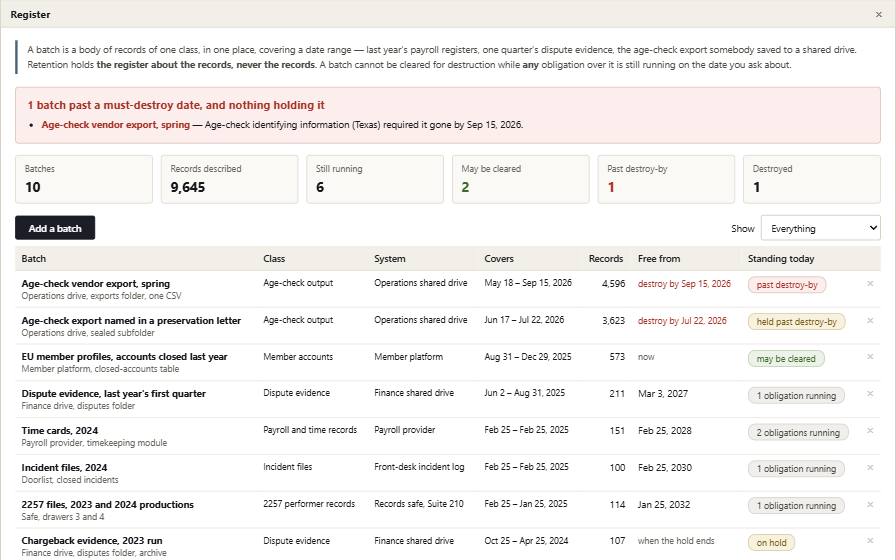
Retention with its example records in itOpen the free demo →

The problem

Every system has its own clock, and nobody is watching all of them.

The 2257 files sit in a safe. Payroll lives with a provider. The accountant has the tax workpapers. Dispute evidence is in a shared drive, and an age-check export somebody downloaded in the spring is in another. Each carries a different period, running from a different date — and a few carry the opposite rule: destroy it, now. The day somebody tidies up is the day one of those gets it wrong.

7 years

2257 records are kept from creation or last amendment or addition — and five years after the producer ceases business. The clock restarts every time the file is touched.

28 CFR 75.4 →
$10,000

per instance, in Texas, for retaining identifying information from an age check. The statute that requires the check forbids keeping what it produced.

Texas HB 1181 →
4 years

for employment tax records, from the date the tax fell due or was paid, whichever is later. Three for most return support; six if income was under-reported by more than a quarter.

IRS →

It will not mark a record destroyable while any obligation over it is still running.

Not a warning. A refusal, with the reason written on it: which rule, running until when, or which legal hold, placed by whom. There is no override — an override is a button somebody presses at five o'clock on a Friday. A hold ends only with a written reason, a date and a name. And a batch past a must-destroy date cannot be marked kept without an active hold: it stays red, counted on the front page, until it is gone.

How it works

A register about your records, never the records

Name the systems

The safe, the payroll provider, the accountant, the shared drives, the vendor export. Who answers for each and where it is — never how to log in. Custodian and Doorlist keep their own clocks for their own records; this is the register across all of them, including the ones we do not make.

Enter the rules, dated

Each rule is what you entered, with the date it applies from and where you read it. A changed period is a new row, not an edit, and a batch is judged by the version in force on the date asked. A history, not a field.

Ask about a date

Pick a batch and a date. Retention says what still runs over it then, and refuses to clear it if anything does. The same batch can be refused this week and allowed next quarter, and it will tell you the day.

What it will never do

It holds the register. It will never hold the records.

A retention tool that stored what it was tracking would be the biggest pile of records in the business, and the first thing a breach took. This one records class, system, location, dates, counts and holds — and nothing you would mind losing.

No records, no media, not one file.There is nowhere in the program to attach anything. A batch is a line describing records that live elsewhere.
No credentials.It records that a system exists and who owns it. There is no field for a login, a password, or a link with a key in it.
No payments, no funds.It never sits in a checkout and never touches money. The merchant category stays software.
Flat fee. Never per record.Pricing that grows with what you register is pricing that discourages registering it — and the batch nobody entered is the one that gets shredded early.

Pricing

Priced per business, not per record

Because the thing you must never be discouraged from doing is writing down another place records are kept.

One office

$90/month

A single business with a handful of systems.

  • Register of batches and systems
  • Rules as a dated history
  • Legal holds with release records
  • The destruction door
  • Must-destroy dates in red
Most take this

Business

$200/month

Every system the business uses, Callboard or not.

  • Everything in One office
  • Unlimited systems and batches
  • Every question asked as of a date
  • Business-ceased tail on 2257 records
  • The clock across every obligation

Group

$480/month

Several businesses under one owner.

  • Everything in Business
  • One register per business
  • Holds that span businesses
  • Priority support

Flat fee, billed monthly, cancel whenever. Your bank statement says Retention Software. Your licence key is emailed to you within two working days of payment.

Checkout is our own bitcoin server, not a card processor — nobody we had to apply to and nobody who can close the account. The button takes you straight to it. Give your email address there — that is where your key is sent.

Questions

The ones we actually get asked

Our accountant and our payroll provider already keep things for the right time.

They keep their copies for their reasons. The question is what you hold, where, and whether anybody in the business knows which of it may go.

Retention does not replace them. It records that they hold something, who answers for it, and which rules run over it — so the day somebody clears out the finance drive, the program can say no.

Why would a records program tell us to destroy something?

Because some statutes require it. Texas and Louisiana forbid an adult site or its verification vendor from keeping identifying information from an age check. A published privacy period for EU members is a promise under the storage-limitation principle.

A batch past one of those dates is counted red on the front page and cannot be marked kept. The only thing that keeps it is an active legal hold, and then the hold is the reason, in writing.

What if two rules disagree?

Then the program says so. A running minimum period still refuses destruction, and the batch stays red if a must-destroy date has passed. That conflict is a question for counsel, and the screen tells you it is one rather than choosing for you.

Is this legal advice?

No. Every rule row is what the operator entered, and every screen that shows one says so. The demo rows were built from sources we read and cite, and each should be checked before you rely on it.

What Retention does is hold what you tell it and apply it consistently to every batch on every date you ask about — which is the part software is good at.

What do I actually get when I pay?

The demo on this page is the whole program, running on invented records. Paying gets you a licence key — one line of text, emailed to the address you give at checkout within two working days. Paste it into the program and from then on it keeps your own records. Until then, nothing you type into it is kept.

The key is checked inside the page, on your own machine. It never calls us, so there is still no account and nothing about your business goes anywhere. If you ever stop paying, your records stay exactly where they are, read-only, and Export still hands you every one of them.

Try to shred something

Open the demo and try to clear the 2257 files: refused, with the rule and the date it runs out. Try the chargeback evidence: its period has run, but a hold is active. The 2019 payroll clears. And the age-check export on the operations drive is red on the front page, and will not be marked kept.