Remonstrance keeps a dated record of every closure — the institution, the reason it gave in its own words, what came back and what is still held — and drafts the complaint to the regulator that supervises it, quoting the 2025 fair-banking order and asking for supervisory review. It says plainly that the order is not a right to sue.
Opens in this browser with an invented creator already in it. No account, no email address, nothing installed.
Open the free demo →
The problem
Executive Order 14331 of August 2025 told the federal banking regulators to remove reputation risk from their guidance and to review institutions for politicized or unlawful debanking — including closing accounts over lawful business activities the provider disfavors. It creates no right to sue. What it gives a debanked business is a regulator told to look, and a complaint built on dates.
regulators were told to remove it from their guidance and review institutions’ practices.
The White House →the order says it creates no right enforceable at law. The complaint is the lever.
Not a reminder. I sent the complaint refuses, with the reason named, while the closure is incomplete, no notice from the institution is fingerprinted, the institution has not first been asked in writing for its specific reason, or the business is not described. There is no override.
How it works
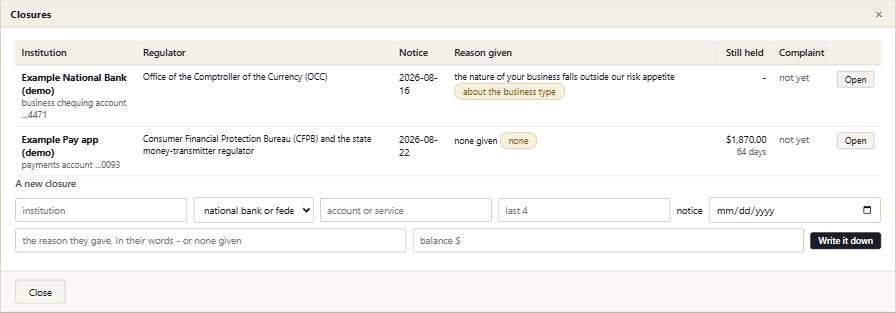
The institution and its kind, the account’s last four digits, the notice date, their reason in their words, and what is still held.
The timeline, their notices fingerprinted in your browser, and the complaint drafted to the OCC, the Fed, the FDIC, the NCUA or the CFPB.
Who you are and what the lawful business does, in the words the complaint quotes.
What it will never do
Remonstrance builds the packet. You send it to the regulator yourself.
Pricing
Against weeks of frozen money.
One closure, one complaint.
A bank and two payment apps at once.
One-time payment. Your bank statement says Remonstrance Software. Refunded in full on request within 30 days if no complaint has been marked sent. Your licence key is emailed to you within two working days of payment.
Checkout is our own bitcoin server, not a card processor — nobody we had to apply to and nobody who can close the account. The button takes you straight to it. Give your email address there — that is where your key is sent.
Questions
It depends on the institution: the OCC for national banks, the Federal Reserve for member state banks, the FDIC for other state banks, the NCUA for credit unions, and the CFPB and your state for payment apps.
Because the complaint is stronger with their answer, or their silence, on the record. Remonstrance asks you to do it first.
No. Section 8(c) says it creates no right enforceable at law. Remonstrance says so in the complaint.
No. It is the record you wish you had kept.
The demo on this page is the whole program, running on invented records. Paying gets you a licence key — one line of text, emailed to the address you give at checkout within two working days. Paste it into the program and from then on it keeps your own records. Until then, nothing you type into it is kept.
The key is checked inside the page, on your own machine. It never calls us, so there is still no account and nothing about your business goes anywhere. If you ever stop paying, your records stay exactly where they are, read-only, and Export still hands you every one of them.
The invented creator’s bank gave “the nature of your business” as its reason, and a payment app is still holding $1,870 with no reason at all. Remonstrance drafts each complaint to the right regulator.