Release Clearance Register
For producers and studios

Everyone in the scene agreed to be in it. The question is whether they agreed to this use, on that day.

Release is the scene-by-scene index of what every performer signed — which form, when, for which formats, channels and territories — and a door that will not record a use their releases did not cover on the day it begins.

Opens in this browser with a worked example producer already in it. No account, no email address, nothing installed.
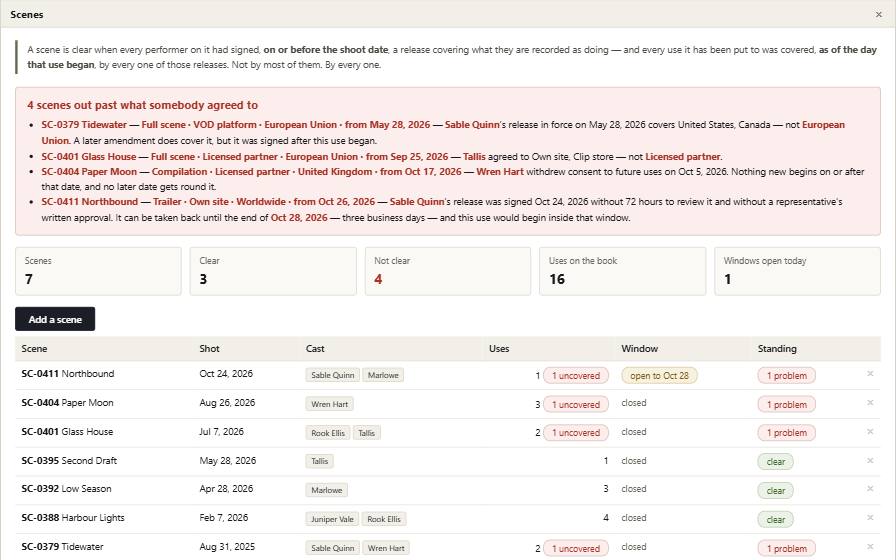
Release with its example records in itOpen the free demo →

The problem

Producers do not fail at getting the release signed. They fail at what happens after.

The release is in a folder. It covered the US and Canada. Eighteen months later a scene goes to a European partner, or into a compilation, or out on the day after it was shot — and nobody opens the folder, because nobody remembers it said anything but yes.

3 business days

to take consent back by written notice, under California Civil Code § 1708.86 — unless the performer had at least 72 hours with the terms, or an attorney, talent agent or manager approved it in writing. The section is written about digitally created or altered depictions; the window is worth keeping for every release.

Cal. Civ. Code § 1708.86 →
Every person

depicted must have given written consent — to being depicted, to public distribution, and to users downloading the content — under the card rules Mastercard enforced from 15 October 2021.

Mastercard rules, summarised →
Appeal to remove

Any person depicted must be able to ask for the content to come down. A producer with no record of what was agreed has nothing to answer that request with.

CommerceGate →

The index answers the question. The paper is what a breach takes.

Release records that a release was signed — which version of the form, when the terms were handed over, when it was signed, who witnessed it, whether a representative approved it — and where the signed original is held. Never the form, never a video statement, never an image, never an identification, never a legal name. There is nowhere in the program to put one.

How it works

Every use is asked as of the day it begins

Index the release

Form version, dates, witness, representative, and what it covers: your own checklist codes, formats, channels, territories, term. A release is a history, not a field — an amendment adding Europe widens next month and does not reach back over last month.

Record the use

One format, one channel, one territory, from one date. The button refuses if any performer's release did not cover it on that date, if a rescission window is open, or if somebody has withdrawn. Every reason is written on it. There is no override.

Answer the request

A rescission inside its window voids the release. A late one is still written down, and stands as a withdrawal. A request to take a scene down gets a seven-business-day clock, and nothing new goes out on that scene while it runs.

What it will never do

No documents. No legal names. Nowhere to put them.

A folder of signed releases with the video statements and the identification stapled to them is the most dangerous file a producer owns. Release is the index to that folder, and never a copy of it.

No signed forms, no video, no images.Not one byte of the paper, the recording or the identification. There is no upload anywhere in the program, which is a stronger promise than a policy saying we would not look.
No legal names.A handle and your own reference. Legal identity belongs in your identity records, examined and indexed there — not copied into a second file for somebody to take.
No override button.A use the releases did not cover is refused, with the reason. An override is a button somebody presses at five o'clock on a Friday.
Flat fee. Never per scene, never per performer.A price that rises with every release you record is a price that discourages recording one — in the one program where an unrecorded release is the whole problem.

Pricing

Priced per producer, not per scene

Because the thing you must never be discouraged from doing is recording another release.

Producer

$120/month

One producer, a few scenes a month.

  • Scene, performer and release index
  • Form versions and your own checklist
  • Uses by format, channel and territory
  • Where every original is held
Most studios

Studio

$300/month

Active production, unlimited scenes.

  • Everything in Producer
  • The use gate, asked as of each start date
  • Rescission windows in business days
  • Withdrawals and takedown requests with their clocks
  • Amendments as a dated history

Studio, several labels

$650/month

More than one label or production company under one owner.

  • Everything in Studio
  • A register per label
  • Closed-day calendars per office
  • Priority support

Flat fee, billed monthly, cancel whenever. Never a percentage of anything. Your bank statement says Release Software. Your licence key is emailed to you within two working days of payment.

Checkout is our own bitcoin server, not a card processor — nobody we had to apply to and nobody who can close the account. The button takes you straight to it. Give your email address there — that is where your key is sent.

Questions

The ones we actually get asked

Our releases are signed and in the safe. Why would we need this?

Keep them there. Release does not want them and has nowhere to put them.

The question is not whether the release exists. It is whether, when a scene is about to go to a new partner in a new territory, somebody can say in seconds whether every person in it agreed to that — as of that day, on the version of the form they actually signed. The safe is storage. This is the index.

Does it actually stop us?

Yes. A use that any performer's release did not cover on its start date cannot be recorded, and the screen says exactly whose release and which word is missing.

There is no override. A door you can walk around is a sign, not a door.

Is the three-day window the law for every release?

Not as written. California's § 1708.86 sets it out for depictions that were digitally created or altered, and the program says so on the screen.

Release applies the same window to every signing as a house rule, and lets you out of it only for the two reasons the section names — 72 hours with the terms, or a representative's written approval. Waiting three business days costs three business days. Not waiting can cost the scene. Take advice on your own forms.

What if a performer changes their mind after the window?

Then it is written down anyway, as what it is: a withdrawal for future uses from that date. Nothing new goes out on that scene after it, and the program will not record a use that tries.

What already went out stays on the book as history. A withdrawal stops what comes next; it does not rewrite what already happened.

Is this legal advice?

No. The windows, channels and checklist hold what you typed and apply it consistently to every scene and every date — which is the part software is good at. None of it replaces a lawyer who has read your form.

What do I actually get when I pay?

The demo on this page is the whole program, running on invented records. Paying gets you a licence key — one line of text, emailed to the address you give at checkout within two working days. Paste it into the program and from then on it keeps your own records. Until then, nothing you type into it is kept.

The key is checked inside the page, on your own machine. It never calls us, so there is still no account and nothing about your business goes anywhere. If you ever stop paying, your records stay exactly where they are, read-only, and Export still hands you every one of them.

Try to put a scene out

Open the demo, open Northbound, and try to record the trailer for today. It will refuse, and tell you whose window is open and until when. Move the date two weeks out and it goes. Then try Paper Moon, where no date works at all.