Rail Floor Records
For clubs and venue operators

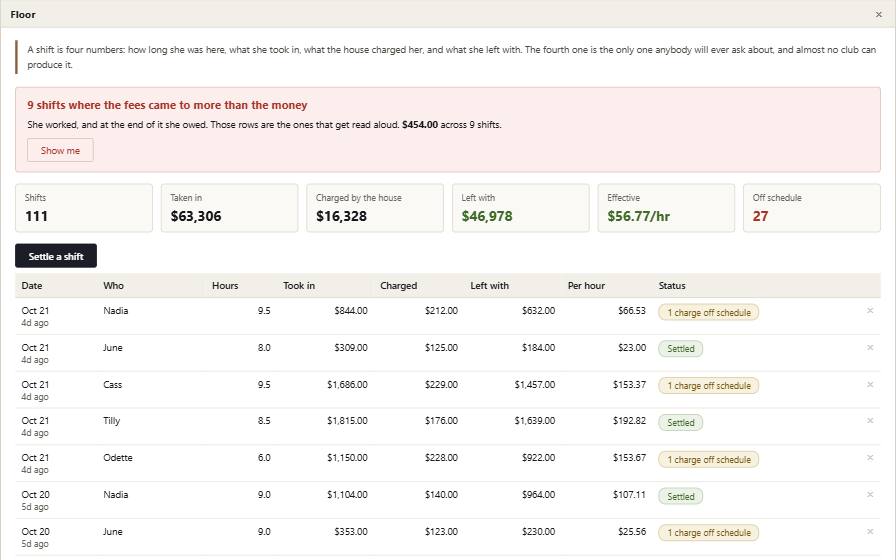
What she took in, what the house charged her, and what she left with.

That third number is the only one anybody will ever ask about in a courtroom — and almost no club in the country can produce it.

Opens in this browser with six weeks of a worked example floor already in it. No account, no email address, nothing installed.

Rail with its example records in itOpen the free demo →

The problem

Clubs do not lose these cases on the merits. They lose them on the records.

The recordkeeping burden under the Fair Labor Standards Act falls on the employer. A club whose entire defence is that she was never an employee has, by its own logic, kept nothing — so when the estimate arrives there is nothing to put against it.

400+

wage-and-hour complaints filed in federal court by dancers between 2006 and 2019. These are not nuisance suits and they do not go the club's way.

ClassAction.org →
$13,000,000

settled by Spearmint Rhino across a class that eventually spanned sixteen clubs in six states. Penthouse Executive Club settled at $8m; another overtime claim at $15m.

FindLaw →
$21,000

recovered per dancer at one Atlanta-area club. Clubs have also agreed to reclassify as a term of settlement, which changes the business permanently.

FindLaw →

The row a plaintiff's lawyer is looking for is the shift where the fees came to more than the money.

She worked, and at the end of it she owed the house. Every one of the large settlements in this sector was built out of rows that looked exactly like that. Rail finds them in your own ledger, in red, before anybody else gets the chance to — and there is no setting to turn it off.

How it works

A shift is four numbers

Post the schedule

House charges and tip-outs, with an honest answer about whether each recipient customarily receives tips. A mandatory pool that reaches house mothers, managers or security is the most reliable way there is to lose the tip credit — and with it the argument that minimum wage was ever met.

Settle the shift

Hours, what she took in, and what she was charged. Rail measures every charge against what is actually posted on the wall, so a desk that quietly started charging a hundred flat shows up as a finding rather than as a baseline.

Read the exposure

Ten control factors, phrased the way an owner would recognise them rather than the way a brief would. Tick them honestly and the arithmetic follows: back wages, deductions returned, liquidated damages, and what that runs to across a two-year class.

What it will never do

It never touches the money, and that is the point

A vendor holding a dancer's earnings becomes a party to exactly the claim this program exists to keep off your floor. Rail records. It does not collect, hold, or move anything.

No money moves through it.The house fee is cash at a desk and stays cash at a desk. We are not a processor, not a wallet and not an escrow — so we can never be named alongside you in something we were hired to help you avoid.
No identity.A working name and a date. There is nowhere in the program for a legal name, an address or a document, because a club holding that material is holding precisely what a breach takes.
No opinion on whether you reclassify.That is your decision with your own lawyer. Rail shows you what a court would actually be looking at, early enough for it to be a decision rather than a deposition.
Flat fee per venue.Never per shift, never per entertainer, and never a percentage. Pricing that rises with house fees is pricing with a view about house fees.
Pricing

Less per year than one settlement costs per week

Take the cheapest of the cases above, divide it across the years it covered, and compare. This is not a close call on price; it is a question of whether the records exist.

Most clubs

One venue

$199/month

The floor, the roster, the schedule and the exposure meter.

  • Shift ledger with take and effective hourly
  • Paid-to-work detection, in red
  • Every charge checked against the posted schedule
  • Tip-pool composition warnings
  • Classification exposure and two-year projection

Group

$149/month per venue

Three venues or more under one owner.

  • Everything in One venue
  • Per-venue and combined figures
  • Shared fee-schedule templates
  • Volume billing on one invoice

With review

$399/month

One venue, plus a quarterly read of your own numbers.

  • Everything in One venue
  • Quarterly written review of your ledger
  • Off-schedule drift flagged before it compounds
  • Priority support

Flat fee per venue, billed monthly. Your bank statement says Rail Software and nothing else. Your licence key is emailed to you within two working days of payment.

Checkout is our own bitcoin server, not a card processor — nobody we had to apply to and nobody who can close the account. The button takes you straight to it. Give your email address there — that is where your key is sent.

Questions

The ones we actually get asked

If I keep these records, am I not building the case against myself?

This is the real objection, it comes up in every meeting, and it deserves a straight answer rather than a reassurance.

The records are discoverable either way. Where an employer has no records, a court works from the employee's own reasonable estimate — which is how clubs end up settling for numbers nobody recognises. Nobody has ever lost one of these because the ledger was too good.

Rail is also the only thing that makes the exposure shrink. Off-schedule charges get fixed in a week. A tip pool gets restructured in a month. Both are visible here and invisible everywhere else.

Does this decide whether my entertainers are contractors?

No, and it is careful not to pretend it can. Rail has no opinion on the classification.

What it has is the list of things courts have actually looked at, and the arithmetic that follows if the answer goes the other way — on assumptions you can see and change, including which minimum wage it measures against.

Who can see our floor numbers?

Nobody. There is no Rail server holding your shifts. The records live in the page and in the browser you opened it in, and export hands you the whole ledger as one file.

We cannot be subpoenaed for what we were never given, and neither can anyone who breaks into us.

How long does it take to run a night?

About as long as the cash-out already takes. Whoever is on the desk ticks what she was charged against the posted schedule and types two numbers.

The program does the rest, and tells you before she leaves whether that shift is about to be recorded as one she paid to work.

What do I actually get when I pay?

The demo on this page is the whole program, running on invented records. Paying gets you a licence key — one line of text, emailed to the address you give at checkout within two working days. Paste it into the program and from then on it keeps your own records. Until then, nothing you type into it is kept.

The key is checked inside the page, on your own machine. It never calls us, so there is still no account and nothing about your business goes anywhere. If you ever stop paying, your records stay exactly where they are, read-only, and Export still hands you every one of them.

Ask yourself what the third dancer on last Saturday left with

Nobody can answer that today, which is the whole problem. The demo floor answers it in one row — and shows nine nights across six weeks where the fees came to more than the money.