Postbag lists everyone who paid you and the form each owes — 1099-K, 1099-NEC, 1099-MISC or none, and why — ticks them off as they arrive, checks each against the payer’s own figures and the payer’s gross against the bank, and drafts the corrected-form request in plain words when a form counted personal payments.
Opens in this browser with an invented performer already in it. No account, no email address, nothing installed.
Open the free demo →
The problem
A payment app or marketplace sends a 1099-K over $20,000 in more than 200 transactions — and may send one below it. A card processor sends one whatever the amount. A business paying fees sends a 1099-NEC. A 1099-K shows gross, before fees, refunds and chargebacks, and a form that counted payments from friends and family over-reports income that was never income. Those are the mismatches that turn into IRS notices.
and more than 200 transactions: the 1099-K threshold — though a form may arrive below it.
IRS →is what a 1099-K reports: before the platform’s fees, refunds and chargebacks.
the date every copy is due to you.
Not a reminder. Close the year refuses, with the reason named, while a required form is missing past its date, a form disagrees with the records and no correction was asked for, or the money does not reconcile to the bank and is not explained. There is no override.
How it works
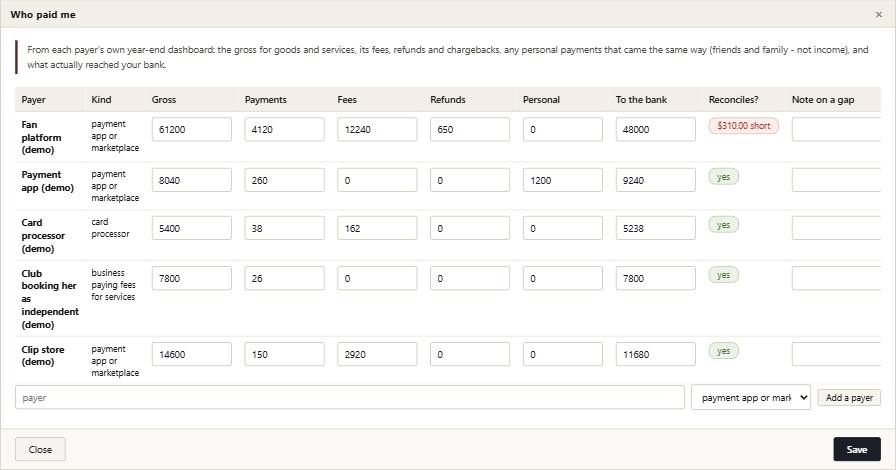
Each payer, its kind, and from its year-end dashboard: gross, payments, fees, refunds, personal payments, and what reached the bank.
The form each owes, when it arrived and what it says. A mismatch gets a drafted correction request to copy and send.
Every payer on one page for whoever does the return.
What it will never do
Postbag writes the correction request; you copy it and send it yourself.
Pricing
Less than the first IRS notice costs to answer.
One performer, every payer.
A small studio with several earners.
Yearly licence. Your bank statement says Postbag Software. Refunded in full on request within 30 days. Your licence key is emailed to you within two working days of payment.
Checkout is our own bitcoin server, not a card processor — nobody we had to apply to and nobody who can close the account. The button takes you straight to it. Give your email address there — that is where your key is sent.
Questions
It shows gross, before fees, refunds and chargebacks. Postbag works the difference out and asks for a note when it still does not reconcile.
Personal payments are not income. Postbag drafts a corrected-form request that names them.
Postbag flags it past its date. The income is still reported.
No. It is the inbox you wish you had kept.
The demo on this page is the whole program, running on invented records. Paying gets you a licence key — one line of text, emailed to the address you give at checkout within two working days. Paste it into the program and from then on it keeps your own records. Until then, nothing you type into it is kept.
The key is checked inside the page, on your own machine. It never calls us, so there is still no account and nothing about your business goes anywhere. If you ever stop paying, your records stay exactly where they are, read-only, and Export still hands you every one of them.
The invented performer is paid through five places: a 1099-K that counted $1,200 of personal payments, a platform whose figures miss the bank by $310, and a club that never sent its 1099-NEC. Postbag will not close the year until each is settled.