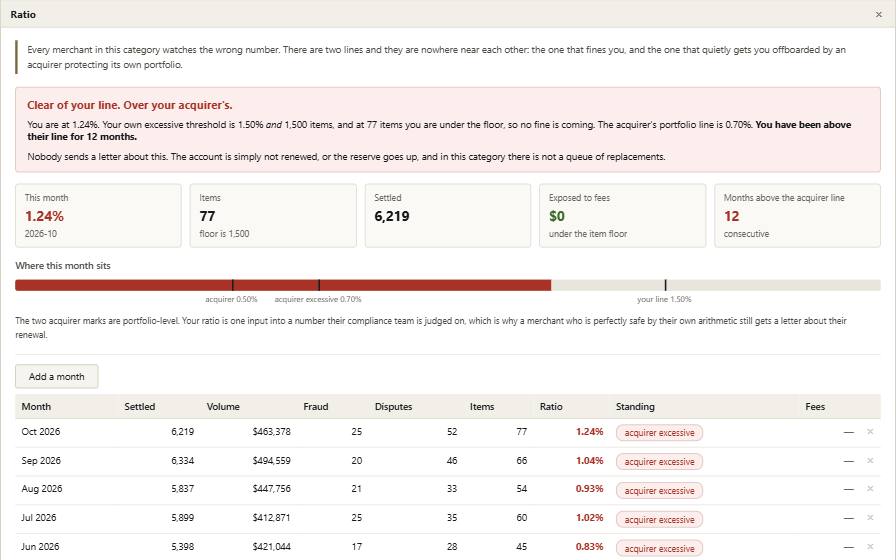
Your excessive threshold is 1.50% and 1,500 items. Your acquirer's portfolio line is 0.70%. Plainwrap draws both on the same axis, which for most merchants is the first time they have seen them together.
Opens in this browser with fourteen months of a worked example settlement file. No account, no email address, nothing installed.
Open the free demo →
The problem
Every merchant in this category has been told to watch 1.5%. Almost none have been told the number their acquirer is actually managing to — and in this category there is not a queue of replacements waiting.
the acquirer's portfolio excessive line, against your own 1.50%. A merchant sitting at 0.9% is clear of their own threshold and is exactly the merchant their acquirer is preparing to drop.
VAMP 2026 playbook →what specialist gateways charge this category, against a normal 2–3%. Shopify permits the products but forbids Shopify Payments for them; Stripe and Square list you as restricted.
Platform comparison →of monthly volume held in rolling reserve. That is not a fee — it is the working capital that was supposed to buy Q4 inventory, sitting in somebody else's account.
cside →An order is released when the destination permits that product category and the age check is on the record — and not before. It refuses rather than warns, and there is deliberately no override, because an override is a button somebody presses at five o'clock on a Friday. A shipment that should not have gone is not a customer-service problem, it is the fine and the licence.
How it works
Settled transactions, volume, fraud items and dispute items — straight off the settlement file rather than from memory. The entire value of the screen is that it disagrees with your impression of the month.
Your ratio drawn against your own excessive threshold and both acquirer marks at once, with the item floor shown for what it is: the only thing between you and $8 a dispute, and it disappears the moment you grow.
The catalogue by category, destinations by what each permits, and a gate on every order. Plus the reserve ladder, so you can see what share of your own cash is frozen and the date any of it moves.
What it will never do
That is the joke at the centre of it, and it is also the reason we can serve this category at all. A vendor holding cardholder data for a high-risk merchant has taken on that merchant's risk profile for free.
Pricing
The worked example has $302,000 frozen. Ten months of the top tier is about three per cent of that. Compare it to that number rather than to your analytics stack.
One brand: ratio, reserve, orders and destinations.
Up to five brands under one owner.
Unlimited catalogue and unlimited destinations.
Flat fee, billed monthly. Never per order and never basis points. Your bank statement says Plainwrap Software. Your licence key is emailed to you within two working days of payment.
Checkout is our own bitcoin server, not a card processor — nobody we had to apply to and nobody who can close the account. The button takes you straight to it. Give your email address there — that is where your key is sent.
Questions
They send you your ratio against your threshold, because that is the number they are contractually obliged to tell you about.
They do not send you their portfolio position, and they will not — because the moment they do, the conversation is about whether they are keeping you. Plainwrap draws the line they are actually managing to.
No. You give it the numbers off the settlement file. That is a deliberate design decision, not a missing feature.
An integration means credentials, and credentials mean that one day a mistake of ours could suspend the account your business depends on. We will not hold that risk on your behalf and we will not ask you to.
The April 2026 drop to 1.50% is in the shipped defaults, and every line is editable on the screen where it matters.
Thresholds move, and a program measuring against last year's numbers is worse than no program at all — because it reassures. So we put them in front of you rather than burying them.
No, and the screen says so twice. Import and sale restrictions move, vary by category, and are enforced by customs services rather than announced.
Those rows are a starting point for a conversation with a freight forwarder and a lawyer. What Plainwrap does is apply your answer consistently to every single order, which is where the failures actually happen.
The demo on this page is the whole program, running on invented records. Paying gets you a licence key — one line of text, emailed to the address you give at checkout within two working days. Paste it into the program and from then on it keeps your own records. Until then, nothing you type into it is kept.
The key is checked inside the page, on your own machine. It never calls us, so there is still no account and nothing about your business goes anywhere. If you ever stop paying, your records stay exactly where they are, read-only, and Export still hands you every one of them.
The worked example sits at 1.24% with no fine coming — 77 items against a 1,500 floor — and has been above its acquirer's line for twelve consecutive months. That is the shape of this business, and most owners have never seen it drawn.