Pigeonhole keeps the list of every place a performer’s business address appears — platform tax profiles, the bank, the IRS, the state, the city licence, the domain registration, the website footer — and which address each one shows. It flags anything still showing home, and keeps the private mailbox itself in good standing: Form 1583, both IDs and their expiry dates.
Opens in this browser with an invented performer already in it. No account, no email address, nothing installed.
Open the free demo →
The problem
A private mailbox at a commercial mail receiving agency keeps home off business records — but only once every platform, bank, agency and registration is changed, and only while the box stays in good standing. USPS Form 1583 sets it up with two IDs per person, one a photo ID with its expiry date. And two places can never be a mailbox: a registered agent’s office, and where 2257 records are kept.
sets up mail delivery through an agent, with the applicant’s photo ID details including its expiry date.
USPS →for each person on the box: a photo ID, and one confirming the address.
a registered agent’s office, or where 2257 records are kept — both need a real street address.
Every place still showing home is flagged. A 2257 statement or registered agent on the mailbox is flagged as needing a real street address. An ID expired or expiring within 60 days is flagged, and so is a driver’s licence used as both IDs. The check lists what is left, on one page.
How it works
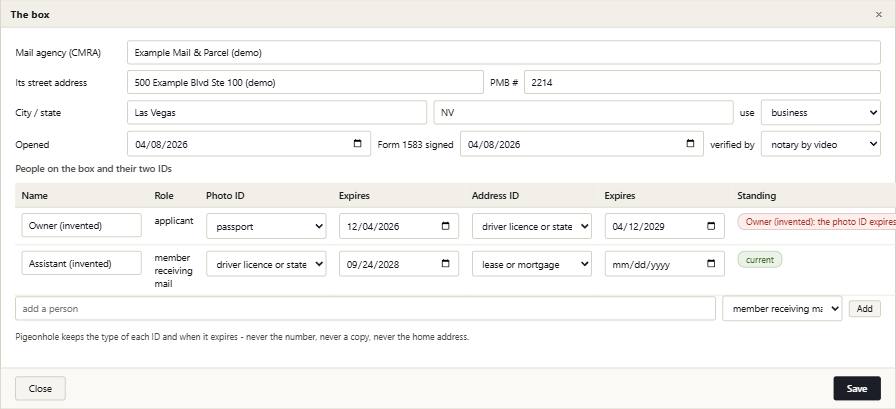
The agency, its street address, the PMB number, when Form 1583 was signed and how it was verified, and everyone on it with two ID types and expiry dates.
Each platform, bank, agency, licence, domain and website, which address it shows, and when it was changed or checked.
Everything still to change or renew, on one page.
What it will never do
Pigeonhole keeps ID types, expiry dates, and which address each place shows — nothing more.
Pricing
Less than a month of the mailbox itself.
One performer and one private mailbox.
Everyone receiving mail at the box.
Yearly licence. Your bank statement says Pigeonhole Software. Refunded in full on request within 30 days. Your licence key is emailed to you within two working days of payment.
Checkout is our own bitcoin server, not a card processor — nobody we had to apply to and nobody who can close the account. The button takes you straight to it. Give your email address there — that is where your key is sent.
Questions
No. It can be one of the two. Pigeonhole flags it when it is used as both.
No. The custodian statement needs the real street address where the records are kept.
The mailbox details, ID types and expiry dates, and which address each place shows. Never the home address, an ID number or a copy.
No. It is the list you wish you had kept.
The demo on this page is the whole program, running on invented records. Paying gets you a licence key — one line of text, emailed to the address you give at checkout within two working days. Paste it into the program and from then on it keeps your own records. Until then, nothing you type into it is kept.
The key is checked inside the page, on your own machine. It never calls us, so there is still no account and nothing about your business goes anywhere. If you ever stop paying, your records stay exactly where they are, read-only, and Export still hands you every one of them.
The invented performer’s passport expires in 40 days, a domain and a city licence still show home, the mailbox is on her 2257 statement, and a bank change has no date. Pigeonhole lists every one.