Novelty Product File
For brands, at product level

A warning that names DEHP, over a report that found DBP, is not a warning.

Novelty keeps the file behind every SKU — what it is made of, who makes it now, what the lab found, what the box says — and will not mark it sellable in a state whose labelling rule it fails. The reason is written on the refusal. There is no override.

Opens in this browser with a worked example line already in it. No account, no email address, nothing installed.
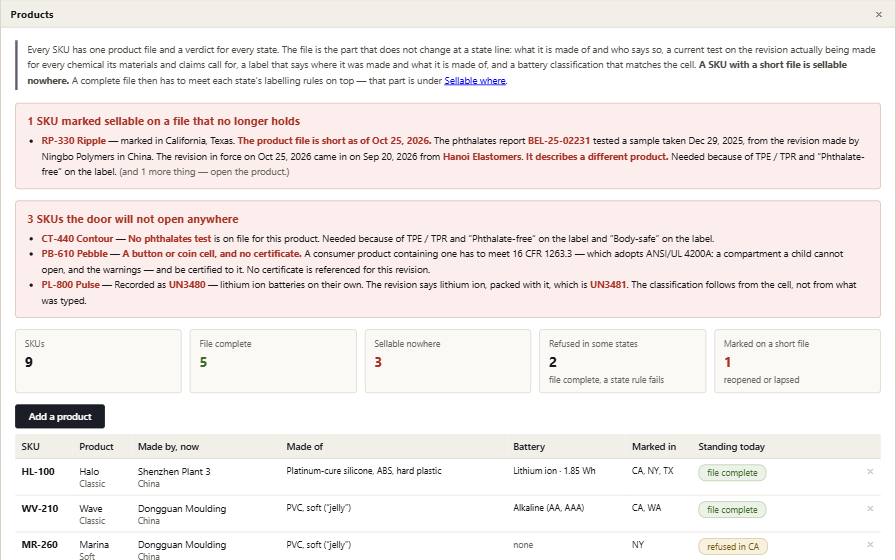
Novelty with its example records in itOpen the free demo →

The problem

Brands do not fail at testing. They fail at the change nobody told compliance about.

The phthalate report is fine. It was run on last year's factory's sample. The box still says the old country and still says phthalate-free, and it is on sale in two states. A test describes the sample it was run on — not the SKU number, not the product page, and not the factory you moved to in the spring.

$2,500

a day, for each violation — the civil penalty ceiling under California's Proposition 65. A box that ships without the warning its test calls for is a violation every day it is on sale.

Proposition 65 →
251

out-of-court Proposition 65 settlements over DEHP in 2024 alone, worth $5.7 million — second only to lead, and largely vinyl and PVC products. Soft vinyl is soft because it is plasticised.

Prop 65 Clearinghouse →
1 Jan 2028

The old short-form warning, which names no chemical, is accepted only on product labelled before this date. Every reprint after it has to name one — and it has to be one the report actually found.

Sidley Austin →

Will not mark a SKU sellable in a state whose labelling requirement it fails.

A SKU is sellable in a state when, as of the date you ask, its product file is complete — materials declared, a current test on the revision actually being made, a label with origin and materials, a battery classification that matches the cell — and it meets every rule you entered for that state. Fail one and the door stays shut, with the report number, the chemical and the label version in the reason. A door you can walk around is a sign.

How it works

Every question is asked as of a date, per item, per state

Record the file, not the files

Report number, laboratory, sample date, issue date, scope, what it found, and where the document is held. No PDFs, no photographs, no label artwork. A product is a list of revisions — supplier, country, materials, cell — each in force from a date, so a change of factory reopens the file on its own.

Enter the states you sell into

California's warning for listed chemicals, Washington's battery marking with the day it starts, a state with no row at all. The table is yours and every screen that shows it says so. Novelty applies what is written, consistently, to every SKU and every date.

Read the matrix

Every SKU against every state, as of any day you type. Sellable, can be marked, refused — with the sentence that explains it — or marked on a file that has since fallen short. Where the brand-level question is whether a destination bans the category, that is Plainwrap's screen, not this one.

What it will never do

No photographs. No lab PDFs. No label artwork. Nowhere to put them.

A compliance file does not need the documents in it. It needs to know which one governs, as of which day, and where it is kept — and a program with no media in it can never be the breach, the subpoena, or the reason a processor looks twice.

No media of any kind.Report number, lab, dates, scope and where the document is held. There is no upload control in the program, which is a stronger promise than a policy saying we would not look.
No override on the door.An override is a button somebody presses at five o'clock on a Friday. If a SKU fails a state, the fix is the label, the test or the file — not a checkbox.
No opinion dressed as a feature.The state rules, the chemical lists and the material table are yours. We ship a starting point and say so on every screen that shows it.
Flat fee. Never per SKU.Pricing that rises with the catalogue discourages recording the SKU you are unsure about, which is the one this program exists for.

Pricing

Priced per brand, not per SKU

Because the thing you must never be discouraged from doing is adding the next item to the file.

Line

$150/month

One product line, a stable factory, selling into a handful of states.

  • Up to 60 SKUs
  • Revisions, tests and label versions as dated histories
  • Battery classification derived from the cell
  • Sellability matrix across your states
Most brands

Catalogue

$300/month

An active catalogue across several factories, selling nationally.

  • Everything in Line
  • Unlimited SKUs and states
  • The per-state door, with no override
  • State rules with start dates, shown before they bite
  • Claims checked against what is on file

Catalogue, several brands

$650/month

A house of brands, or an importer filing for others.

  • Everything in Catalogue
  • Separate files per brand
  • Rule tables shared or kept apart
  • Priority support

Flat fee, billed monthly. Your bank statement says Novelty Software. Your licence key is emailed to you within two working days of payment.

Checkout is our own bitcoin server, not a card processor — nobody we had to apply to and nobody who can close the account. The button takes you straight to it. Give your email address there — that is where your key is sent.

Questions

The ones we actually get asked

We already test everything.

Good. The question is not whether a report exists. It is whether the report that governs today was run on a sample of the revision you are making today, is still inside the currency you set, and covers what the box claims.

The most common failure is a perfectly good report on last year's factory's sample. Novelty knows which revision each sample came from, so a supplier change reopens the file without anybody remembering to.

Does it actually stop us selling in California?

It will not mark the SKU sellable there, and it says why: the report, the chemical it found, and the label version that carries no warning or names the wrong chemical.

It does not reach into your storefront. It is the record of what you decided and on what file — and the refusal is the part that makes the record worth having.

Is this Plainwrap?

No. Plainwrap works at brand level: which categories a destination bans, which orders may ship, the dispute ratio. Novelty works at the item: what the label on this SKU has to say in this state.

A SKU can pass here and still be a category somebody will not let you ship to. Each program says where the other one starts.

What about the lithium cells?

The classification is derived from the cell and how it is packed — UN3481 inside or packed with the product, UN3480 on its own, UN3091 and UN3090 for lithium metal — and a SKU whose recorded number disagrees is sellable nowhere.

It also flags what the freight booking needs to know: the UN 38.3 summary, the small-battery limits, and the 30% state-of-charge limit by air for batteries over 2.7 Wh packed with equipment.

What do I actually get when I pay?

The demo on this page is the whole program, running on invented records. Paying gets you a licence key — one line of text, emailed to the address you give at checkout within two working days. Paste it into the program and from then on it keeps your own records. Until then, nothing you type into it is kept.

The key is checked inside the page, on your own machine. It never calls us, so there is still no account and nothing about your business goes anywhere. If you ever stop paying, your records stay exactly where they are, read-only, and Export still hands you every one of them.

Open it and look at California

Open the demo and go to Sellable where. One SKU has a complete file and is sellable in three states. In the fourth it is refused, and the reason is one sentence long.