Limelight works the section 199A deduction for one performing-arts business: whether it is performing arts at all, by where its receipts come from; then the threshold, the phase-in range, the applicable percentage, the wage and property limit, the income cap and the 2026 minimum — every step, with the other year’s rules side by side.
Opens in this browser with an invented creator already in it. No account, no email address, nothing installed.
Open the free demo →
The problem
Section 199A gives most pass-through businesses a deduction of 20% of qualified business income. Performing arts is a specified service field under section 1202(e)(3)(A), so above the threshold the deduction shrinks and, at the top of the phase-in range, is gone. The planning — salary, retirement contributions, how the business is split — has to happen before the year ends, not when the preparer calls.
of qualified business income: the pass-through deduction under section 199A.
26 U.S.C. § 199A →the phase-in range for single filers ($150,000 joint) for years beginning after 2025.
26 U.S.C. § 199A →Keep this for the file refuses while an input is missing. A tax year Limelight does not hold asks for its threshold from the IRS instructions rather than inventing one. A kept result is frozen with the inputs it was worked from.
How it works
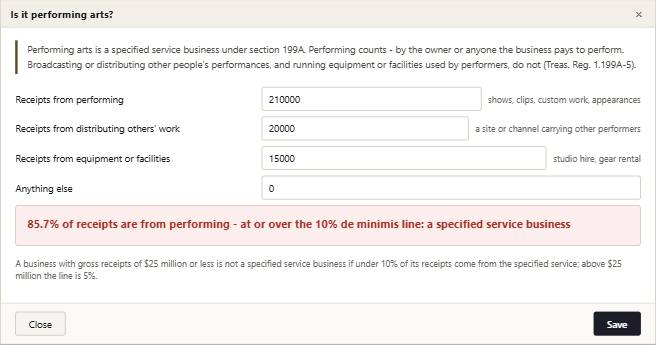
Receipts by kind: performing, distributing others’ work, equipment or studio hire, anything else. The share from performing decides it.
Year, filing status, taxable income, net capital gain, QBI, W-2 wages, property basis and participation.
Every step to the deduction, and the share of a full 20% you keep, beside the other year’s rules.
What it will never do
Several businesses, REIT dividends and PTP income are not worked here. Your preparer handles the return.
Pricing
At these incomes the difference is thousands of dollars.
One performing-arts business, one year.
This year and next, for planning.
Yearly licence. Your bank statement says Limelight Software. Refunded in full on request within 30 days. Your licence key is emailed to you within two working days of payment.
Checkout is our own bitcoin server, not a card processor — nobody we had to apply to and nobody who can close the account. The button takes you straight to it. Give your email address there — that is where your key is sent.
Questions
It turns on the receipts. Performing is; distributing other people’s performances and renting out equipment or a studio are not. A 10% de minimis line applies.
The phase-in range widened to $75,000 ($150,000 joint), and a $400 minimum deduction applies for active QBI of $1,000 or more.
The levers are planning ones — salary, retirement contributions, how the business is split — and they need to happen before the year ends. Limelight shows what is at stake.
No. It is the working your preparer would otherwise show you in April.
The demo on this page is the whole program, running on invented records. Paying gets you a licence key — one line of text, emailed to the address you give at checkout within two working days. Paste it into the program and from then on it keeps your own records. Until then, nothing you type into it is kept.
The key is checked inside the page, on your own machine. It never calls us, so there is still no account and nothing about your business goes anywhere. If you ever stop paying, your records stay exactly where they are, read-only, and Export still hands you every one of them.
The invented creator performs on her own site, distributes two other creators there and rents out her studio: 86% performing, $25,000 into the 2025 phase-out. She keeps $9,075, about a quarter of the full deduction. Limelight shows every step.