Gatehouse holds what every property you run was doing in every state, on every day — and counts the days you were exposed before anybody noticed.
Opens in this browser with a worked example estate already in it. No account, no email address, nothing installed.
Open the free demo →
The problem
In January 2023 one state required age verification. There are now twenty-seven, the Supreme Court has settled whether they are allowed to, and each statute has a different trigger, a different list of accepted methods, and a different answer to whether you may keep what you collected.
states with a live age-verification requirement, up from one in January 2023. Twenty-six by June 2026, and the trend has not turned over.
State-by-state table →Free Speech Coalition v. Paxton upheld Texas HB 1181 in June 2025. The “this will all be struck down” posture is no longer available to anyone.
National Law Review →Several of these statutes require you not to retain what you collected. Operators keeping a verification log to prove compliance have built the breach that ends them.
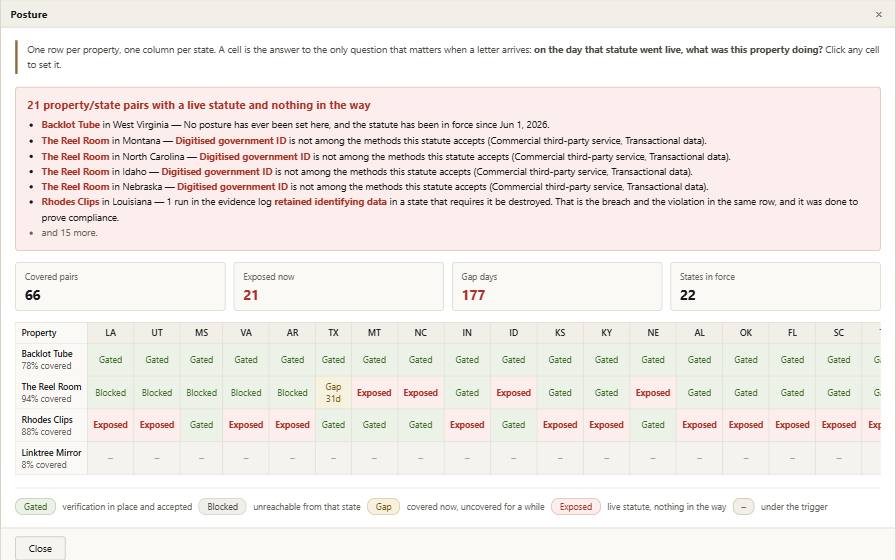
National Law Review →They will ask about a date. Gatehouse computes exposure as of the day each statute took effect — never as of today — and counts the gap days between the law going live and your property doing something about it. Those days do not expire because today is fine, and they are the entire case against you.
How it works
Each property and how much of it is covered material — because every one of these statutes triggers on a share, not on whether any of it exists. A link hub that is a tenth explicit is a different legal object from a tube site that is nine tenths, and Gatehouse will not treat them alike.
Gated, geo-blocked or open, per property per state, and the date it started. The date is the whole record. That is what turns a folder of assumptions into something you could hand to a lawyer.
One row per property, one column per state. Green where you are covered and were covered on time. Red where a live statute is running against a property doing nothing. Amber where you are fine now and were not for eleven months.
What it will never do
Verifying somebody is a liability with a whole industry already competing to hold it. Knowing where you stand is the part nobody sells — and the part that is safe for us to.
Pricing
One hour with a lawyer in this area costs most of the first tier — and what you get back is a memo, rather than a ledger that still exists in eighteen months.
One property, every jurisdiction.
Up to twelve properties under one owner.
Unlimited properties, and the table kept current.
Flat fee, billed monthly, cancel whenever. Never a percentage of anything. Your bank statement says Gatehouse Software. Your licence key is emailed to you within two working days of payment.
Checkout is our own bitcoin server, not a card processor — nobody we had to apply to and nobody who can close the account. The button takes you straight to it. Give your email address there — that is where your key is sent.
Questions
Keep them. Gatehouse is not one and does not want to be.
Your vendor proves a user is an adult. It has no idea whether you were switched on in Montana in January, which methods Kansas actually accepts, or that four of your markets require you to destroy the data your vendor just handed you. Those are different questions, and the second set is the one an Attorney General asks.
In the page and in the browser you opened it in. There is no Gatehouse server holding your estate, no account, and no database with your postures in it.
That is not an omission, it is the same refusal the rest of the program runs on: we cannot lose, leak or be subpoenaed for what we were never given. Export writes the whole thing out as one file you hold.
No, and it says so on the screens that matter. The jurisdiction rows are a starting point assembled from the public record, and every one should be checked against the statute before you rely on it.
What Gatehouse does is hold what you tell it and apply it consistently across every property and every date — which is the part software is genuinely good at, and the part a memo cannot do.
Then record that, and Gatehouse will treat it as a posture like any other, with a date on it.
Blocking is a revenue decision and gating is a liability decision. The point of the matrix is that it lays the two side by side per property, which is a comparison almost nobody currently has in front of them.
The demo on this page is the whole program, running on invented records. Paying gets you a licence key — one line of text, emailed to the address you give at checkout within two working days. Paste it into the program and from then on it keeps your own records. Until then, nothing you type into it is kept.
The key is checked inside the page, on your own machine. It never calls us, so there is still no account and nothing about your business goes anywhere. If you ever stop paying, your records stay exactly where they are, read-only, and Export still hands you every one of them.
The demo estate has a hundred and sixteen of them, and one property exposed in a state that went live in June that nobody had noticed. Yours will look different. It will not look like zero.