Docket Payee Records
For platforms and agencies paying people

The 1099 is filed in January. The mistake is made on the day the money goes.

Docket reads your payout file and stands beside the rail. No row is released unless that payee had a W-9 on file and a matched TIN on the pay date, and the year's total is classified against that year's threshold. It never moves a dollar and never holds a TIN.

Opens in this browser with a worked example platform and a payout file waiting to go. No account, no email address, nothing installed.
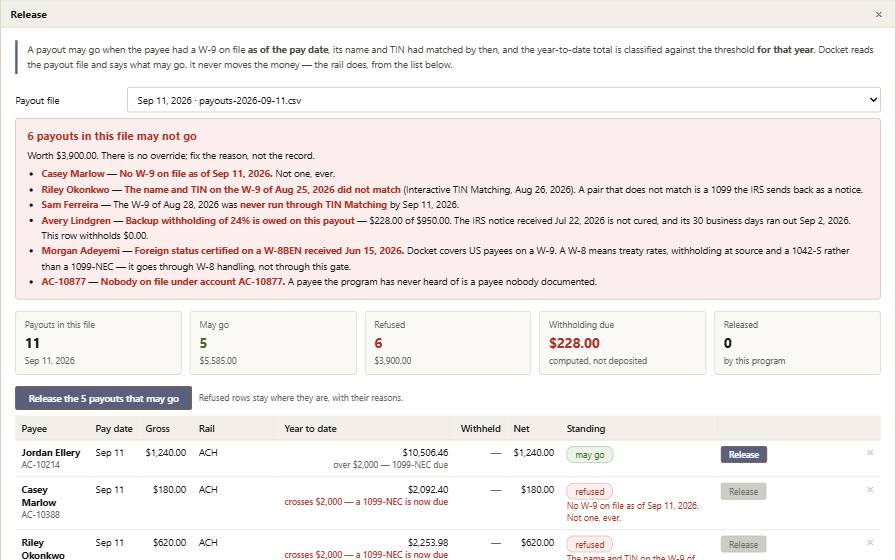
Docket with its example records in itOpen the free demo →

The problem

Nobody decides not to collect the W-9. It just never comes up until January.

A payee paid a few hundred dollars a month is on nobody's list until the month the total crosses the line — and then the 1099 is filed against a name nobody checked. When the IRS writes back to say the name and number do not match, the answer is 24% of the next payment, on a clock counted in business days. And the payments that went through a payment app are on somebody else's 1099-K already, which is how the same dollar ends up on two forms.

$2,000

The 1099-NEC line for payments made in 2026, up from $600 for 2025, and indexed for inflation from 2027. A threshold is now a row per year, not a number anybody remembers.

IRS — Form 1099-NEC instructions →
24%

Backup withholding, owed on the payments that follow when a payee never gave you a TIN or the IRS tells you the one on file is wrong. Docket works out the date it starts and refuses a payout that does not carry it.

IRS — Backup withholding →
$340

per information return filed after August 1 or not at all, for returns due in 2026 — $680 where the IRS calls it intentional disregard. Per payee, not per company.

IRS — Information return penalties →

The door is at the payout, not at year end.

A row in the payout file cannot be marked released unless the payee had a W-9 on file as of the pay date, the name and TIN on it had matched, and the year-to-date total is classified against the threshold for that year — $600 for a 2025 payment, $2,000 for a 2026 one. A W-9 that arrives the day after the money went proves nothing about the day it went. There is no override.

How it works

Every question is asked as of the pay date

Read the payout file

Account, pay date, amount, rail — the file your payout system already writes. Docket reads it and never writes back. Files that already went are recorded rather than refused, and every payment in them that had nothing behind it is counted on the front page.

Record the paper, never the number

The date the W-9 arrived and where it is kept. The date TIN Matching ran, by which method, and what it said. The IRS notice, and the business-day clocks it starts. A history with dates on it, so the question is always which document governed that day.

Release what may go

Each row says may go or refused, with the sentence that explains it. What may go becomes a list for the rail. The same derivation reconciles the year: the 1099-NEC figure worked out from the rail each payment went on, set beside what your 1099 vendor drafted.

What it will never do

It reads the payout file. It never sends one.

The obvious version of this product moves the money and keeps the numbers. Both are how a vendor in this business ends up holding the risk its customers were trying to get rid of.

It never moves money.Not a payout rail, not escrow, not a money transmitter. It reads the file and hands back a list of what may go. Software that touches the funds needs licences in most of the country — and joins the risk category it exists to keep you out of.
It holds no TINs.It records that a name and TIN matched, on what date, by which method, and where the W-9 itself is kept. There is no field for the number, masked or otherwise. A list of names beside Social Security numbers is worse to lose than the money.
No override.A payout short of its papers does not go, whoever is asking and however small it is. An override is a button somebody presses at five o'clock on a Friday.
Flat fee. Never a percentage of what goes out.A vendor paid on your payout volume is a participant in it. Ours does not move when you have a good month.

Pricing

Priced per platform, not per payout

Because the thing you must never be discouraged from doing is putting another payee through the gate.

Agency

$199/month

Up to 250 payees a year, one payout rail.

  • Payee documentation as a dated history
  • Release gate on every payout file
  • Year-to-date classified against each year's threshold
  • Exposure: what already went undocumented
  • No TIN stored, anywhere
Most platforms

Platform

$399/month

Up to 5,000 payees a year, any number of rails.

  • Everything in Agency
  • Backup-withholding clocks on IRS notices
  • 24% computed on the row, or the row is refused
  • 1099-NEC against 1099-K reconciliation
  • Release list handed back for the rail

Platform, large

$799/month

Unlimited payees and payout files.

  • Everything in Platform
  • Unlimited payees and rails
  • Each new year's threshold row flagged before the first payout in it
  • Priority support

Flat fee, billed monthly. Never a percentage of anything you pay out. Your bank statement says Docket Software. Your licence key is emailed to you within two working days of payment.

Checkout is our own bitcoin server, not a card processor — nobody we had to apply to and nobody who can close the account. The button takes you straight to it. Give your email address there — that is where your key is sent.

Questions

The ones we actually get asked

Can it just send the payouts as well?

No, and it never will. The day Docket moved a dollar it would be a money transmitter, and you would be buying your payout risk back from a vendor instead of getting rid of it.

It reads the file your payout system writes, says row by row what may go and why the rest may not, and hands back the list. Your rail does the sending, exactly as it does now.

TIN Matching needs the number. Why won't Docket keep it?

Because the match is run in the IRS's own e-Services by you or your 1099 vendor, and what Docket needs is the answer: matched, on what date, by which method. That is the part an auditor asks about.

The number itself adds nothing to a gate and everything to a breach. There is no field for it on any screen.

The law lets us pay without a TIN if we withhold 24%. Why does Docket refuse?

It does let you. Docket does not, because a payment with no W-9 behind it is exactly the year of payouts with nothing behind them that this program exists to prevent.

Where the IRS has told you a TIN is wrong and the notice has run its course, the lawful path is withholding, and Docket takes it: it computes the 24%, and releases the row only once it is on it.

What about payees outside the US?

They are documented on a W-8, not a W-9, and withheld and reported under a different regime. A payee on a W-8 is refused here with a sentence saying so.

That is deliberate. Treaty rates belong in a program built for them, not bolted onto this one.

Is this tax advice?

No. It is a ledger that argues with you. The threshold rows ship with the figures the IRS publishes and say where each came from, and every one should be checked against the current instructions before you rely on it.

What Docket does is apply them the same way to every payee on every pay date, which is the part software is good at and the part a spreadsheet quietly stops doing in March.

What do I actually get when I pay?

The demo on this page is the whole program, running on invented records. Paying gets you a licence key — one line of text, emailed to the address you give at checkout within two working days. Paste it into the program and from then on it keeps your own records. Until then, nothing you type into it is kept.

The key is checked inside the page, on your own machine. It never calls us, so there is still no account and nothing about your business goes anywhere. If you ever stop paying, your records stay exactly where they are, read-only, and Export still hands you every one of them.

Open the demo and try to release the file

The demo platform's September file has eleven rows. Five may go. Six may not, each for a different reason — and one is a payee paid about three hundred dollars a month since March whom nobody ever asked for a W-9, whose next payment takes the year past $2,000.