Deadbolt records, model by model, how each connected toy meets California’s connected-device law — a password unique to each unit, a setup that forces a new one before first use, a conforming security label, or another reasonable feature with written reasoning — and the dated proof it works on the firmware shipping now. New firmware without new proof is flagged.
Opens in this browser with an invented toy maker already in it. No account, no email address, nothing installed.
Open the free demo →
The problem
California Civil Code 1798.91.04 makes the maker of a connected device equip it with a reasonable security feature. A device reachable from outside the home network is deemed to meet it if its preprogrammed password is unique to each unit, or if it makes the user set a new one before first use. A toy that ships with the same default password on every unit meets neither.
the California law: a connected-device maker must include a reasonable security feature.
Cal. Civil Code →The same default password on every unit is a stop. A “unique” password that is a common default is a stop. A toy called local-only that pairs through an app or cloud is a stop. Proof is tied to a firmware version, so new firmware with no new proof is flagged, not assumed.
How it works
Its firmware, whether it can be reached from outside the home, its route, the default password, and what it collects.
Several units checked for different passwords, screenshots of a forced reset, the label certificate, or a written review — on a firmware version.
Every finding and each model’s route and current proof.
What it will never do
Deadbolt records what you checked and when. It does not probe any device.
Pricing
Less than one unit off the line.
Every connected model one maker sells.
The same, two months free.
Subscription. Your bank statement says Deadbolt Software. Refunded in full on request within 30 days. Your licence key is emailed to you within two working days of payment.
Checkout is our own bitcoin server, not a card processor — nobody we had to apply to and nobody who can close the account. The button takes you straight to it. Give your email address there — that is where your key is sent.
Questions
If it cannot be reached from outside the home network, mark it local-only. If it pairs to an app or cloud that can, it is not.
Whatever shows the route works on the shipping firmware: units checked for different passwords, screenshots of a forced reset, or the label certificate.
No. Toys that collect voice or a child’s profile have a separate children’s privacy duty. Deadbolt reminds you; it does not cover it.
No. It is the record you wish you had kept.
The demo on this page is the whole program, running on invented records. Paying gets you a licence key — one line of text, emailed to the address you give at checkout within two working days. Paste it into the program and from then on it keeps your own records. Until then, nothing you type into it is kept.
The key is checked inside the page, on your own machine. It never calls us, so there is still no account and nothing about your business goes anywhere. If you ever stop paying, your records stay exactly where they are, read-only, and Export still hands you every one of them.
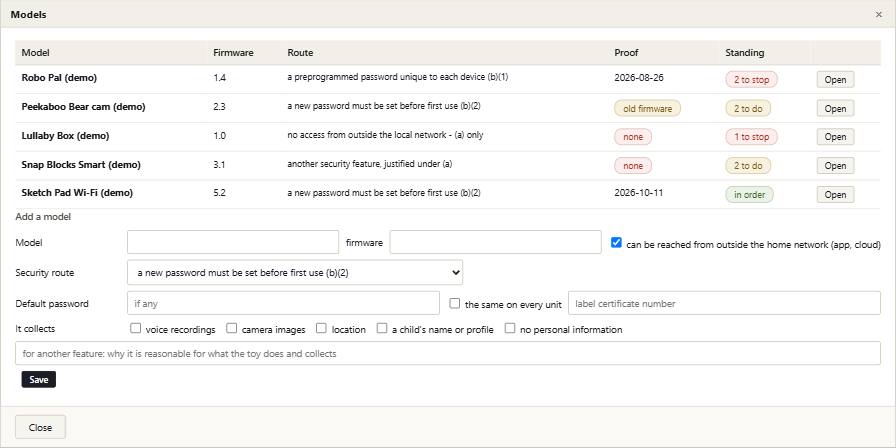
The invented maker’s robot ships with “admin” on every unit, a camera bear is proven only on old firmware, a music box called local-only pairs to the cloud, and the smart blocks have no written reasoning. Deadbolt names every one.