Daybook keeps the records section 28 of the Prostituiertenschutzgesetz asks an operator for — each worker’s name or alias, the registration and counselling certificates, every working day and every payment each way — and it will not put anybody on today’s sheet while a certificate is missing or out of date.
Opens in this browser with an invented premises already in it. No account, no email address, nothing installed.
Open the free demo →
The problem
Section 27 says nobody works until the operator holds a valid registration and a valid counselling certificate. Section 10 says counselling is repeated every twelve months, every six under 21. Section 28 says every working day and every payment is written down on the same day, kept two years, and then deleted. A paper book does none of the arithmetic and never deletes anything.
The records are kept for two years from the day they were made, and the personal data in them is deleted once that time has passed.
ProstSchG s.28(5), (7) →Health counselling is repeated at least every twelve months — every six months under 21.
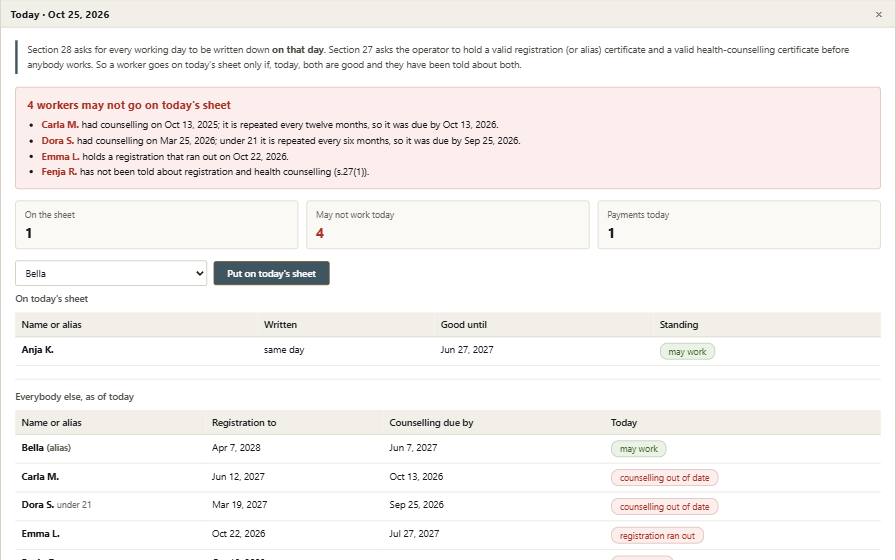
ProstSchG s.10(3) →Not a reminder. The button refuses, with the reason beside it, while a worker has not been told about registration and counselling, holds a registration that has run out or not yet started, or holds a counselling certificate older than twelve months (six under 21). Asked as of the day. There is no override.
How it works
Name or alias, the registration’s validity and issuing authority, the counselling certificate’s date and issuing authority, and the day the worker was told about both. Never a copy of either certificate.
Who worked today, and every payment each way: name, date, amount. Anything written after its own day is stamped late with the day it was written — recorded honestly, never hidden.
Nothing can be deleted one line at a time inside its two years. Past them, everything due goes in one press, and a worker who has left goes with their last line.
What it will never do
The law says what goes in the book, and Daybook has a field for exactly that and nothing more.
Pricing
Because the one thing you must never be discouraged from doing is writing one more name in the book.
One licensed premises.
One premises, more than one person writing.
Several premises under one operator.
Flat fee, billed monthly. Never per worker or per day. Your bank statement says Daybook Software. Your licence key is emailed to you within two working days of payment.
Checkout is our own bitcoin server, not a card processor — nobody we had to apply to and nobody who can close the account. The button takes you straight to it. Give your email address there — that is where your key is sent.
Questions
Yes, when they hold a valid alias certificate. The alias goes in, with that certificate’s validity and issuing authority instead of the name.
Write it down. Daybook keeps it with the day it was actually written and marks it late. It never lets a line pretend to be on time.
Inside two years the record is the record. Write a correcting line and say why. After two years, everything due is deleted in one press, as the law asks.
Not yet. The screens are in English, with the section numbers of the Prostituiertenschutzgesetz beside each rule.
No. It is a book that argues with you. Read sections 10, 27 and 28 with somebody who advises on them, and ask your authority what it wants to see.
The demo on this page is the whole program, running on invented records. Paying gets you a licence key — one line of text, emailed to the address you give at checkout within two working days. Paste it into the program and from then on it keeps your own records. Until then, nothing you type into it is kept.
The key is checked inside the page, on your own machine. It never calls us, so there is still no account and nothing about your business goes anywhere. If you ever stop paying, your records stay exactly where they are, read-only, and Export still hands you every one of them.
One worker on today’s sheet already. Another cannot go on, because her counselling certificate is a year and twelve days old — the same person who was on the sheet two weeks ago. A third is under 21 and past her six months, a fourth’s registration ran out on Tuesday, and a worker who left in 2024 has six lines waiting to be deleted.