Coffer records every crypto payment’s dollar value at the moment it arrived — once as self-employment income, once as what it cost you — matches later sales to the earliest units in that wallet with their holding period, and will not close a tax year while a value has no source or a sale outruns what was held.
Opens in this browser with an invented creator already in it. No account, no email address, nothing installed.
Open the free demo →
The problem
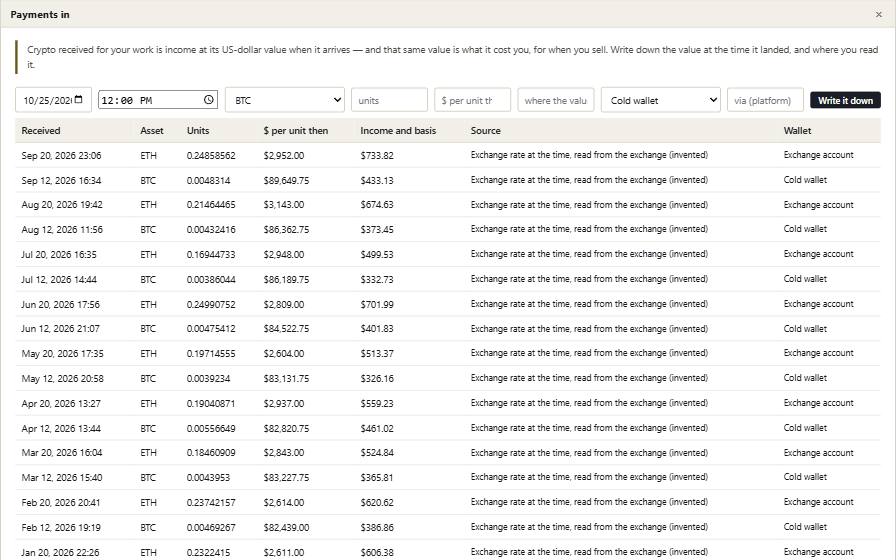
Crypto received for your work is ordinary income at its dollar value when it arrives — self-employment income if you are independent — and that same value is your basis when you sell. Get it wrong and you pay twice, or not at all and find out later. A year of tips, three coins and two wallets is a spreadsheet nobody keeps.
Digital assets received for services are ordinary income at their US-dollar fair market value when received.
IRS digital asset FAQs 57-58 →That same value is your basis for a later sale. For an independent contractor it is self-employment income too.
IRS digital asset FAQs 59-60 →The holding period starts the day after you received it. More than a year is long-term.
IRS digital asset FAQ 50 →Not a reminder. Close the tax year refuses, with each item listed, while any payment in has no dollar value or no note of where the value came from, or any sale is for more units than its wallet held. A sale bigger than the wallet is refused at the counter. A closed year is frozen. There is no override.
How it works
What arrived, how much, the date and time, its dollar value then and where you read it, and which wallet.
Coffer matches it to the earliest units in that wallet, shows the basis, and splits the gain short-term and long-term.
Self-employment income, short- and long-term gains, ready for your preparer — once every figure has its source.
What it will never do
Coffer is a ledger, not a wallet. It connects to nothing.
Pricing
One price however many tips arrive.
One creator, billed yearly.
Several wallets and coins.
A studio keeping logs for up to ten creators.
Flat fee, billed yearly. Your bank statement says Coffer Software. Your licence key is emailed to you within two working days of payment.
Checkout is our own bitcoin server, not a card processor — nobody we had to apply to and nobody who can close the account. The button takes you straight to it. Give your email address there — that is where your key is sent.
Questions
From the exchange or price service you use, at the date and time the payment landed. Write down which, so you can show it later.
Coffer matches sales wallet by wallet, as the IRS has required since 2025. Units in one wallet never cover a sale from another.
The rules allow it with records made at the time; Coffer uses earliest-first, the default when you have not. Ask your preparer before choosing otherwise.
No. It is a log that argues with you.
The demo on this page is the whole program, running on invented records. Paying gets you a licence key — one line of text, emailed to the address you give at checkout within two working days. Paste it into the program and from then on it keeps your own records. Until then, nothing you type into it is kept.
The key is checked inside the page, on your own machine. It never calls us, so there is still no account and nothing about your business goes anywhere. If you ever stop paying, your records stay exactly where they are, read-only, and Export still hands you every one of them.
2024 is closed. 2025 cannot close yet: November’s ether tip has a value with no note of where it came from, and December’s sale took more ether out of the exchange account than was ever in it.