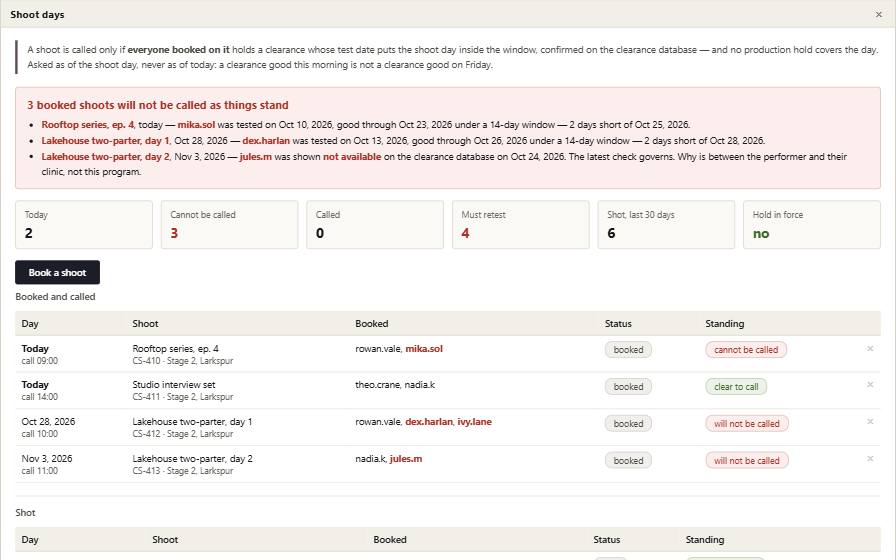
Callsheet holds each booked performer’s last clearance date and asks, as of the shoot day, who is inside the window, who lapses before call and who must retest — and it will not call the shoot while anybody is short. Dates only. Never a result.
Opens in this browser with a worked example studio already in it. No account, no email address, nothing installed.
Open the free demo →
The problem
A clearance runs from the day the sample was taken, not the day the schedule was drawn up. A performer tested sixteen days ago looks cleared on a call sheet made last week; a clearance shown on a phone screen was never looked up on the database; an industry hold closes everything while the dates still say yes. Each one is a shoot that should not have happened, found out after it did.
The industry clearance service counts a clearance as good for fourteen days from the day you go to get tested, not from the day the result comes back — and results usually take up to 48 hours.
Free Speech Coalition, PASS →The clearance database holds only a work-clearance status, never test results, and producers are told to check the database itself rather than paper or screenshots.
Free Speech Coalition, PASS →A production hold, called when there is a significant infection risk to the performer pool, closes the database and suspends production — for every performer, whatever their dates say.
Free Speech Coalition, PASS →Not a warning, not an amber badge. The Call button refuses, with the reason written beside it, and it asks the question as of the shoot day. A clearance never looked up on the database is not a clearance. A performer added to a called shoot is asked the same question at the moment of booking. A hold stops everything inside it. There is no override, because an override is a button somebody presses at seven in the morning with a crew standing around.
How it works
The day the performer was tested, the day you looked it up on the database, who looked, and whether it said available. That is all there is a field for. The latest test on or before the shoot day governs it, and a check confirmed after a shoot proves nothing about the shoot.
How long a clearance lasts is your protocol, typed once in Settings, and the program works out the last good day for every check. Who lapses before call, and the days a retest has to fall between to be back in time, are worked out for every coming shoot.
Everyone booked cleared for the day and no hold over it, or the shoot is not called. Somebody short can still be booked a week out — the board shows them red and lists when they must retest — but once a shoot is called, nobody short is added to it.
What it will never do
Health information about performers is the most sensitive thing a production company could ever hold, and the clearance system was built so that producers never hold it. Callsheet keeps that promise: a date, a yes or a no, and nothing else.
Pricing
Because the one thing you must never be discouraged from doing is checking one more performer.
One independent producer, every shoot.
One studio, several producers and sets.
Several studios under one owner.
Flat fee, billed monthly. Never per shoot, per scene or per performer. Your bank statement says Callsheet Software. Your licence key is emailed to you within two working days of payment.
Checkout is our own bitcoin server, not a card processor — nobody we had to apply to and nobody who can close the account. The button takes you straight to it. Give your email address there — that is where your key is sent.
Questions
Keep checking it. Callsheet does not replace it and does not want to.
The database tells you about today. It does not tell you that the performer you booked for Friday will be two days outside the window by then, or that the clearance on the call sheet was read off a screenshot. Those are questions about dates, asked about a day that has not happened yet — which is what a schedule is.
Yes. A shoot with anybody booked who is not cleared for its day, or inside a production hold, is not called in the program, and nobody short is added to a called shoot.
There is no override. A door you can walk around is a sign, not a door.
Nowhere in Callsheet, on purpose. The clearance system was designed so that producers see only yes or no, and this program has no field for anything else.
What it keeps is a date, a yes or a no, who looked it up and when. A breach of it would yield a schedule.
The one you type. The clearance service publishes fourteen days from the test, and the demo uses that; your studio or your performers’ agencies may follow something stricter, and the program will not invent a number for you.
No. It is a schedule that argues with you. Whether a performer is fit to work is the clinic’s and the clearance service’s call; what this program does is make sure nobody forgets to ask on the right day.
The demo on this page is the whole program, running on invented records. Paying gets you a licence key — one line of text, emailed to the address you give at checkout within two working days. Paste it into the program and from then on it keeps your own records. Until then, nothing you type into it is kept.
The key is checked inside the page, on your own machine. It never calls us, so there is still no account and nothing about your business goes anywhere. If you ever stop paying, your records stay exactly where they are, read-only, and Export still hands you every one of them.
Two shoots are booked today. One can be called. The other cannot, because a performer tested fifteen days ago is outside the window this morning — the same performer who was cleared for the same series a week ago. Thursday’s shoot has a clearance that was only ever seen on a phone.