Byline holds each registered stage name’s date and classes, puts the year five-to-six declaration and the year nine-to-ten renewal on a calendar with their grace periods and fees — and will not sign the yearly check while any window is open with nothing filed.
Opens in this browser with an invented studio already in it. No account, no email address, nothing installed.
Open the free demo →
The problem
A US trademark registration only stays alive if its owner files a declaration of use between the fifth and sixth year, and a renewal between the ninth and tenth and every ten years after. Miss the window and the six months of grace, and the registration is cancelled — with no way to revive it. A performer’s name has to be applied for again from scratch, by which time somebody else may hold it.
The first declaration of use is due between the fifth and sixth year after registration.
USPTO post-registration FAQs →per class on time, $425 per class in the six-month grace period — for each section filed.
USPTO post-registration FAQs →A registration cancelled for a missed declaration or renewal cannot be reinstated. A new application is needed.
USPTO post-registration FAQs →Not a reminder. Sign this year’s check refuses, with each mark named, while any mark’s window is open or in grace with nothing filed, or a mark has been cancelled and not recorded as let go on purpose. A filing before its window opens, or after its grace, is refused. There is no override.
How it works
The mark, its registration number, the date and the classes.
Every declaration and renewal window, when it opens and closes, the grace, and what it costs for the classes you keep.
Record each filing as you make it. Once a year, sign the check — it will not sign while a name is at risk.
What it will never do
Byline holds the mark and its registration details, not the person behind it.
Pricing
A name you have registered is worth keeping.
One registered mark, billed yearly.
Up to five marks, billed yearly.
Up to twenty-five marks, billed yearly.
Flat fee, billed yearly. Your bank statement says Byline Software. Your licence key is emailed to you within two working days of payment.
Checkout is our own bitcoin server, not a card processor — nobody we had to apply to and nobody who can close the account. The button takes you straight to it. Give your email address there — that is where your key is sent.
Questions
No. The USPTO does not accept it before the window opens, and Byline refuses to record it.
File now; it still counts, at the higher fee. Byline shows the grace fee for the classes you keep.
It cannot be revived. Apply again, or record in Byline that you let it go on purpose so the check can be signed.
No. It is a calendar that argues with you.
The demo on this page is the whole program, running on invented records. Paying gets you a licence key — one line of text, emailed to the address you give at checkout within two working days. Paste it into the program and from then on it keeps your own records. Until then, nothing you type into it is kept.
The key is checked inside the page, on your own machine. It never calls us, so there is still no account and nothing about your business goes anywhere. If you ever stop paying, your records stay exactly where they are, read-only, and Export still hands you every one of them.
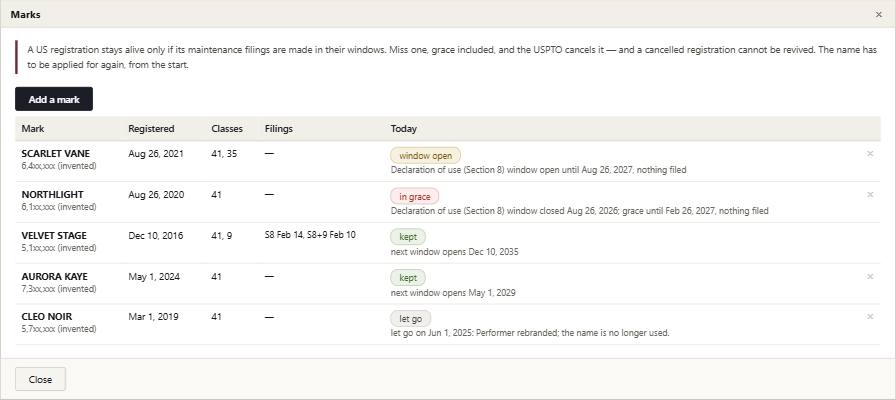
Five names. One renewed in February. One young. One let go after a rebrand. And two that will not let this year’s check be signed: Scarlet Vane’s declaration window opened in August, and Northlight’s closed in August and has until February in grace.