Broadcaster asks, as of the session’s own date, whether everyone on camera held a passing check that was still current — and will not open the session if anybody did not. Then it keeps the record of who was on, and where the evidence is, in a form that survives being asked for.
Opens in this browser with a worked example platform already in it. No account, no email address, nothing installed.
Open the free demo →
The problem
A creator verified at signup, a re-check that failed on Tuesday, a guest who walked into somebody else’s room and was never checked at all. Live is where the records rules are hardest to keep, because there is no edit and no week between the shoot and the publish in which somebody can notice the paperwork is short. By the time anybody looks, the session has already happened.
For anything performed live on the Internet, the federal records rule expects a copy of the depiction long enough to identify each performer in it and tie them to their age records. That copy belongs in your recording store. The index that says who, and where, is the part that gets asked for.
28 CFR § 75.2 →Mastercard’s adult-content standards, in force from 15 October 2021, require merchants to verify the age and identity of everyone depicted and to monitor live streams as they happen, with the ability to take them down.
Summary of the 2021 standards →The maximum sentence for a first violation of the federal record-keeping statute. A subsequent one carries a minimum of two and a maximum of ten.
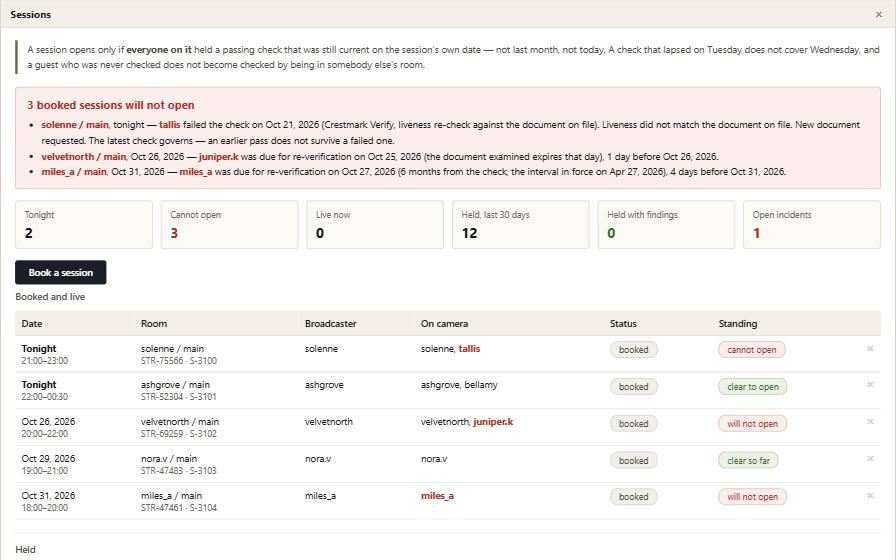
18 U.S.C. § 2257(i) →Not a warning, not an amber badge. The Open button refuses, with the reason written beside it, and it asks the question as of the session’s own date — a check that was good last month is not a check that was good tonight. A guest added to a live room is asked the same question at the moment of adding. There is no override, because an override is a button somebody presses at five to nine with a room waiting.
How it works
Which vendor, what method, on what date, with what result and reference — and where the evidence is held. A check is a history, not a field: the latest one made on or before a date governs that date, and a failed re-check supersedes the pass that came before it.
How long a check lasts is derived, never typed: the re-verification interval that was in force on the day it was made, cut short by the expiry of the document it examined. The interval is your policy and it is kept as a history too, so tightening it cannot be quietly undone after the fact.
Everyone on it current as of tonight, or it stays shut. Guests are added one at a time and each is checked as they are added. Somebody who appeared anyway is not refused — that would only take them off the books — it is recorded as an incident that stays open until somebody with a name writes down what was done.
What it will never do
A face-and-document library is the most dangerous thing a live platform can own. It is what a breach takes, what a subpoena reaches, and what turns one bad night into every creator on the platform outed under their legal name. Broadcaster is the index that points into your vendor’s vault and your recording store. It is neither of those.
Pricing
Because the one thing you must never be discouraged from doing is putting another session through the door.
One platform, sessions and the clock.
One platform, every room, every guest.
Several brands under one owner.
Flat fee, billed monthly. Never per session, per minute or per token. Your bank statement says Broadcaster Software. Your licence key is emailed to you within two working days of payment.
Checkout is our own bitcoin server, not a card processor — nobody we had to apply to and nobody who can close the account. The button takes you straight to it. Give your email address there — that is where your key is sent.
Questions
Keep them. Broadcaster is not one and does not want to be.
Your vendor tells you a person passed on a day. It does not know whether that pass was still good on the night of a particular session, under the interval you had in force then, or whether the guest who walked into the room at eleven was ever checked at all. Those are the questions an acquirer and an investigator ask, and they are questions about dates.
Yes. A session with anybody on it who was not current on its date will not open in the program, and a guest who is not current will not be added to a live one.
There is no override. A door you can walk around is a sign, not a door.
In your recording store, where it already is. Broadcaster records where it is held, per session, and will not close a session that cannot say.
It has nowhere to put the copy itself, on purpose. The index is what gets asked for first. The copies are what a breach takes.
Because refusing to write down that an unchecked person was on camera would not take them off camera. It would only take them off the books.
So it goes in, loudly, against the session it happened on, and it stays open until somebody with a name writes down what was done.
No. It is a register that argues with you. The re-verification interval is your own policy, not a statutory number, and the screens say so. How the federal records rules apply to your platform is an hour with a lawyer who does this.
The demo on this page is the whole program, running on invented records. Paying gets you a licence key — one line of text, emailed to the address you give at checkout within two working days. Paste it into the program and from then on it keeps your own records. Until then, nothing you type into it is kept.
The key is checked inside the page, on your own machine. It never calls us, so there is still no account and nothing about your business goes anywhere. If you ever stop paying, your records stay exactly where they are, read-only, and Export still hands you every one of them.
Two sessions are booked tonight. One opens. The other will not, because a guest’s routine re-check four days ago failed — the same guest who was clear in the same room ten days ago. Tomorrow’s will not open either, because a document expires today.