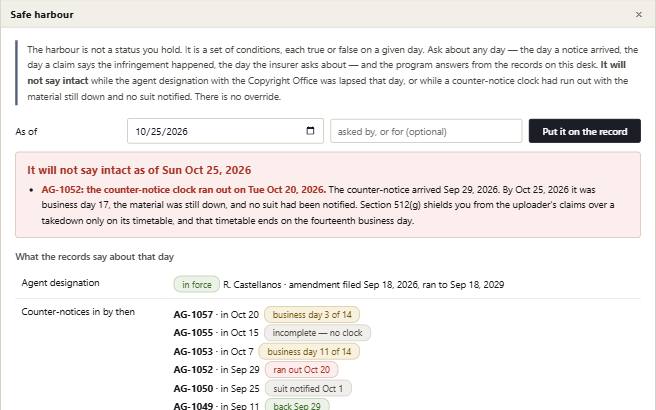
Agent keeps the four things the harbour depends on — the registered agent and its renewal, the takedown log, the counter-notice clock and the repeat-infringer policy — for the platform that receives notices. Ask it about any date and it will not tell you the harbour was intact while the registration was lapsed or a counter-notice clock had run out.
Opens in this browser with a worked example platform already in it. No account, no email address, nothing installed.
Open the free demo →
The problem
A designation that expired because the reminder emails went to an agent who had left. A counter-noticed upload put back on day eight because somebody counted calendar days. An account on its third strike left open because it was a good account. Each one is a date, sitting in an inbox that was never kept as a record.
A designated agent expires three years after it is registered unless it is amended or resubmitted. The reminders go by email to the contacts on file — which is no help if the agent on file has left.
U.S. Copyright Office →Business days, not calendar days. After a counter-notice arrives the material goes back not less than ten, nor more than fourteen, business days later — unless the complainant tells your agent first that they have filed.
17 U.S.C. § 512(g)(2)(C) →The ceiling on statutory damages per work for wilful infringement. That is the exposure the safe harbour exists to take off the table, one upload at a time.
17 U.S.C. § 504(c) →Ask about any day — today, the day a notice arrived, the day your insurer asks about. If the Copyright Office designation had lapsed by then, or a counter-notice had run past its fourteenth business day with the material still down and no suit notified, the word intact does not appear, and the reasons are written on the door. There is no override. The same desk refuses to put material back before the tenth business day, to close a notice with no action and no date, and to close one against an account that crossed your repeat-infringer line with nothing written down about it.
How it works
Typed or pasted: the sender, the work, the URLs, the account handle, and which of the six things a notice has to contain are actually in it. Complete, partial or deficient is derived from that, never picked from a list.
Every filing with the Copyright Office as a dated row. The expiry is derived three years on, a gap between two filings is found for you, and every notice that arrived inside the gap is marked as arriving outside the harbour.
Counter-notices in business days on your calendar. Strikes measured against the policy that was in force on the day each one landed. The account that crossed the line and was left open is on the front page, because that is the row the case turns on.
What it will never do
A takedown desk is exactly where a platform is tempted to keep copies — of the upload, of the screenshots in the notice, of whatever a crawler turned up. Every one of those copies is a liability with its own subpoena attached.
Pricing
Because the thing you must never be discouraged from doing is writing down a notice you received.
A smaller service that needs the designation and the log kept straight.
One platform's legal desk, every notice and every account.
Several services under one legal desk.
Flat fee, billed monthly. Never per notice, never per account, never a percentage. Your bank statement says Agent Software. Your licence key is emailed to you within two working days of payment.
Checkout is our own bitcoin server, not a card processor — nobody we had to apply to and nobody who can close the account. The button takes you straight to it. Give your email address there — that is where your key is sent.
Questions
Exactly two things, checked from your own records as of the day you asked about: an agent designation with the Copyright Office was in force that day, and no complete counter-notice had run past its fourteenth business day with the material still down and no suit notified.
It is not an opinion that nothing else is wrong. Every status you put on the record is kept, with the day it was made and the day it was about, so what the desk said and when is part of the history too.
Because a designation lasts three years from the day it is filed, and the Copyright Office's reminders go to the contacts on file. When the agent on file has left, the reminders leave with them.
Agent keeps every filing as a dated row and derives the expiry, so a lapse is found rather than remembered — and every notice that arrived inside one is marked, because a filing made afterwards does not reach back over the gap.
Yes. A restoration dated before the tenth business day after the counter-notice arrived is refused, and so is one on a counter-notice that is missing something, one the complainant was never sent, and one after the complainant has told your agent they filed.
There is no override. Late restorations are the one thing it records rather than refuses, because refusing a late one would only keep the material down longer.
The statute does not define one. Agent counts Monday to Friday, less the federal holidays published by the Office of Personnel Management, loaded as dated rows you can add to or remove.
If your counsel counts differently, change the calendar and every window in the program moves with it.
No. Cox v. Sony narrowed when a service provider is contributorily liable for its users. The Court described the DMCA as creating defences rather than liability, and did not change what the safe harbour requires.
The same opinion credited Cox's warnings and enforcement as evidence it did not intend infringement. A dated record of what you enforced is worth more after that decision, not less.
No. It holds what you tell it and applies it the same way every time, as of the date that matters. It is a docket that argues with you, and it is most useful in the week before you need a lawyer.
The demo on this page is the whole program, running on invented records. Paying gets you a licence key — one line of text, emailed to the address you give at checkout within two working days. Paste it into the program and from then on it keeps your own records. Until then, nothing you type into it is kept.
The key is checked inside the page, on your own machine. It never calls us, so there is still no account and nothing about your business goes anywhere. If you ever stop paying, your records stay exactly where they are, read-only, and Export still hands you every one of them.
The demo platform has a counter-notice past its fourteenth business day, still down. Ask the safe-harbour screen about today and read what it will not say. Then ask about a day inside last summer's designation lapse, try to put back the counter-notice on its third business day, and try to close the latest notice against the account over the repeat-infringer line.