Affiliate Partner Ledger
For the programme buying traffic

The affiliate you terminated in March applied again on Tuesday. New handle. Same payee.

Affiliate is the ledger a programme keeps behind its network: the W-9 that has to stand up on the payment date, the traffic sources you prohibit, and a termination record that holds up when the affiliate disputes it.

Opens in this browser with a worked example programme already in it. No account, no email address, nothing installed, and nothing on your site.

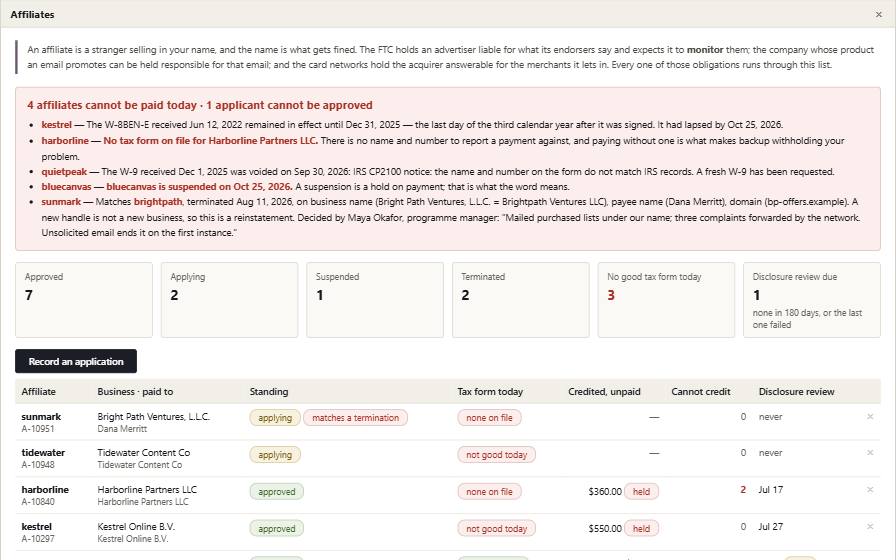
Affiliate with its example records in itOpen the free demo →

The problem

An affiliate is a stranger selling in your name, and the name is the one that gets fined.

The FTC's Endorsement Guides make the advertiser liable for what its endorsers say, and expect it to make a reasonable effort to know what its network is saying. Under CAN-SPAM the company whose product an email promotes can be held responsible for it, not only the affiliate who sent it. And the card networks hold the acquirer answerable for its merchants — which is why an acquirer drops a merchant whose affiliates it cannot account for. Every one of those runs through the same list of strangers, and the list usually lives in a spreadsheet with a status column.

$2,000

The 1099-NEC line for tax years beginning after 2025, up from $600, and adjustable for inflation from 2027. Affiliate keeps the line as a dated history, not a constant, and will not guess the indexed figure.

IRS — 1099-NEC instructions →
24%

Backup withholding when a payee has not given you a TIN in the required manner, or the IRS says the one you have is wrong. Paying commission with no W-9 on file is how that becomes your problem.

IRS Topic 307 →
$53,088

Per email in violation of CAN-SPAM. Both the company whose product is promoted and the company that sent the message may be held legally responsible, and you cannot contract that away.

FTC CAN-SPAM guide →

No payout without a W-9. No reinstatement without the reason on file.

A payout is approved only when the payee held a W-9 — received, in their own name, TIN-matched, not voided — on the payment date, not the day somebody finally chased it. A terminated affiliate can come back, but only with both halves written down: why they were let go, dated, with who decided; and why they are being let back, dated, with who approved it. A new handle that matches a terminated affiliate on the business name, the payee or a domain is treated as the same reinstatement. Refused without them, and there is no override — an override is a button somebody presses at five o'clock on a Friday.

How it works

Every question is asked as of the day it happened

Read the export

The CSV your network already produces. No pixel on your site, no postback, no login to the network. A conversion is credited only if, on the day it happened, the affiliate was in good standing, the source was permitted, the buyer was somewhere you sell and the creative was one you approved. A source banned last month does not reach back and take a sale from the spring.

Record the paper, not the number

That a W-9 arrived, in what name, that the name and number were matched and when, and where the form itself is kept. A tax form is a history, not a field: which one governs a payout depends on the date the money goes.

Write the termination down

The date, the reason and who decided — and the same three for any reinstatement. The program remembers the business name, the payee and the domains of everybody you have let go, and treats a new handle that answers to any of them as a reinstatement. When the affiliate disputes it, the record answers.

What it will never do

It never sees a click, and never holds a number.

An affiliate program is exactly the kind of business that gets asked to “just add a tracking endpoint” and “just keep the TINs, it would make matching certain”. Each of those would make the ledger the most attractive thing in the building to steal or subpoena.

No pixel, no postback, no server.It reads the export the network gives you. There is nothing on your site and nothing listening, so it can never be accused of stuffing a cookie or taking an attribution it did not earn.
No taxpayer identification numbers.Form, name, received, matched, held where. The number stays on the form, wherever you keep the form. It is the one thing on it a breach wants.
No creatives, no media.Codes and descriptions — which banner, approved when, retired why. Never the files.
No payments, no custody, no credentials.It says what may be paid, to whom and on what date. You pay it, from your account, the way you always have. No bank details, no network logins.
Flat fee. Never a percentage.A vendor paid on your traffic is a vendor that wants more of it, including the kind you just prohibited.
Pricing

Priced per programme, never per sale

Because the thing you must never be discouraged from doing is recording another affiliate — especially the one you are about to terminate.

Ledger

$120/month

A small programme on one network, up to 25 affiliates.

  • W-9 and W-8 records, with no numbers
  • Payout gate as of the payment date
  • Termination record with reason and decider
  • Reads one network's export
Most programmes

Programme

$250/month

An active programme, up to 250 affiliates.

  • Everything in Ledger
  • Reinstatement door, including new handles that match
  • Prohibited sources, blocked places and creatives, each dated
  • Credit decided as of the day of the sale
  • 1099-NEC year, with the threshold as a history
  • Disclosure reviews on a clock

Network

$600/month

Unlimited affiliates, several networks' exports.

  • Everything in Programme
  • Unlimited affiliates
  • Exports from more than one network
  • Priority support

Flat fee, billed monthly. Your bank statement says Affiliate Software. Your licence key is emailed to you within two working days of payment.

Checkout is our own bitcoin server, not a card processor — nobody we had to apply to and nobody who can close the account. The button takes you straight to it. Give your email address there — that is where your key is sent.

Questions

The ones we actually get asked

Our network already tracks all of this.

It tracks clicks and sales, and it is good at that. Affiliate does not compete with it and does not want to see a click.

What the network does not know is whether the W-9 was matched before you paid, whether the source was on your prohibited list on the day of the sale, or that the applicant who signed up on Tuesday is the business you terminated in March under a different handle. Those are your records, and they are what you are asked for.

Does it actually stop a payout?

Yes. A payee without a W-9 that stands up on the payment date cannot have a payout approved in the program, and a payout dated into the past is not a question the door answers.

It never moves the money. It writes down that an amount may go on a date; you pay it.

Can we ever take a terminated affiliate back?

Yes. Terminations are sometimes wrong, and a program that pretends otherwise gets walked round.

What it will not do is reinstate anybody without the reason on file: the termination's date, reason and who decided, and the reinstatement's own written reason, date and who approved it. Both stay in the history. A termination with nothing written down cannot be reversed until somebody writes it down — and that is also the termination that would not have held up when they disputed it.

Why not keep the TIN? Matching would be certain.

Because the ledger would become the hoard. The program matches on the business name, the payee name and the domains — things an affiliate publishes, or tells you in order to be paid.

The price of that is honest: it will occasionally refuse a stranger who shares a name with somebody you let go. It says exactly which name. A wrong refusal costs a polite email.

Is $600 still the 1099 line?

Not for payments after 2025: the IRS instructions put it at $2,000, adjustable for inflation from 2027. The program keeps the line as a dated table and will not guess the indexed figure.

Not tax advice. It is a ledger that argues with you; your accountant decides what is filed.

What do I actually get when I pay?

The demo on this page is the whole program, running on invented records. Paying gets you a licence key — one line of text, emailed to the address you give at checkout within two working days. Paste it into the program and from then on it keeps your own records. Until then, nothing you type into it is kept.

The key is checked inside the page, on your own machine. It never calls us, so there is still no account and nothing about your business goes anywhere. If you ever stop paying, your records stay exactly where they are, read-only, and Export still hands you every one of them.

Open it and watch it refuse

Harborline is owed commission and has no W-9. Sunmark is Brightpath under a new name. Foxglove was terminated with nothing written down, and is disputing it. Each is refused on screen the moment the demo loads — and each says exactly what would let it through.